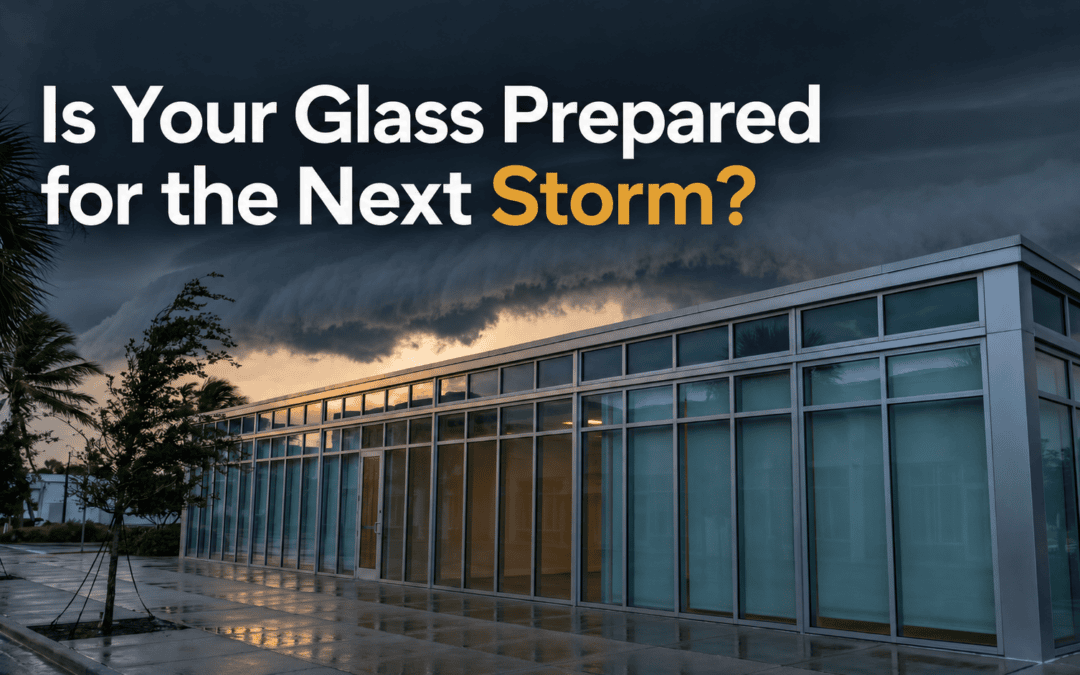
Every year around this time, we start getting the same call. A homeowner in Virginia Beach or a property manager in downtown Norfolk sees a storm forming in the Atlantic, looks at a wall of glass facing the water, and asks a version of the same question: can you put something on this so it doesn’t come through my living room?
The honest answer is more complicated than most window film companies will tell you. Security film does something real and valuable during a storm. It also has limits, and the companies that gloss over those limits are the reason a lot of people end up disappointed after a bad night. At Skyline Tinting, we install genuine 3M™ Safety & Security Window Film across Chesapeake, Virginia Beach, Norfolk, Portsmouth, Suffolk, Hampton, and Newport News. Here is the straight version — what security film genuinely does in a hurricane, what it does not do, where it can and cannot be properly anchored, and how to decide what your property actually needs.
The Short Version
Security window film holds shattered glass together so it does not become flying shrapnel — and that is a genuine, well-documented safety benefit. But film applied to glass alone is not impact-rated glazing, and the frame attachment systems that add pane retention work far better on commercial framing than on typical residential windows. Anyone who tells you a piece of film makes your house hurricane proof is selling you something.
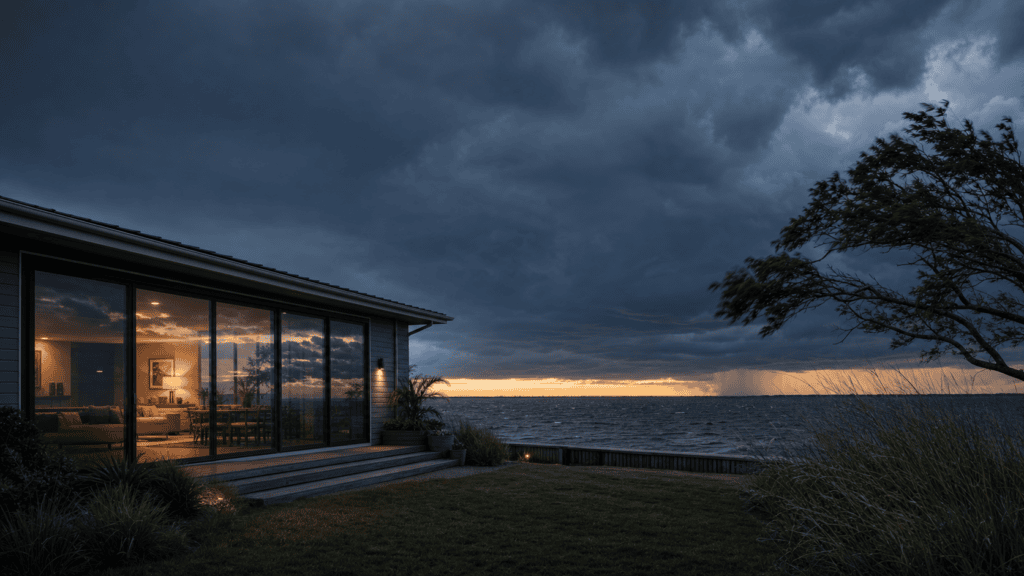
Large patio doors and windows are typically the weakest point for storm damage by allowing water to enter the home.
Storm Glass Protection at a Glance
Sources: ASTM E1886 / E1996 impact test standards; 3M™ Impact Protection Attachment (IPA) Sealant technical data; Pentagon Protection US anchoring system documentation.
A Quiet Forecast Is Exactly How Coastal Properties Get Caught
NOAA’s outlook for the 2026 Atlantic season calls for below-normal activity, with 8 to 14 named storms, 3 to 6 hurricanes, and 1 to 3 major hurricanes. In July, Colorado State University trimmed its numbers even further, down to about nine named storms and a single major hurricane — potentially one of the least active seasons in over a decade.
Here is the thing about a quiet season: it does absolutely nothing for you if the one storm that forms decides to come up the Chesapeake. A below-normal outlook is a statistical statement about the entire Atlantic basin. It is not a forecast for your address.
Peak season runs from mid-August through October, which means the window that matters most is opening right now. Quiet years are dangerous precisely because they lower everyone’s guard. The properties that get hurt worst are almost never the ones that were thinking about the storm in August.
What Security Window Film Actually Does
Start with the failure mode that film is built to prevent. When a window breaks in a storm, the glass itself is only the first problem. Annealed glass breaks into large, heavy shards. Tempered glass breaks into thousands of small pieces. Either way, in a high-wind event those pieces do not simply fall down — they get picked up and driven inward at speed. Interior injuries during hurricanes are frequently caused by glass, not by the debris that broke the glass in the first place.
Security window film is a thick, multi-layer polyester film bonded to the interior surface of the glass with a very aggressive adhesive. When the glass fractures, the film holds the fragments together in a single sheet. The glass still breaks. It just does not become shrapnel. That matters in three concrete ways.
There is a related benefit that has nothing to do with storms at all. Safety film also addresses spontaneous glass breakage, which is a genuine and under-discussed problem in commercial buildings — we covered the causes in what Hampton Roads businesses need to know about spontaneous tempered glass breakage. And the injury-prevention logic is exactly why we install it in schools, which we wrote about in security window films and student safety.
What Security Window Film Does Not Do
Now the part that gets left out of most sales pitches.
Film alone is not impact-rated glazing. This is the single most important sentence in this article. Hurricane impact protection is measured against real, published standards — primarily ASTM E1886 and ASTM E1996. The common benchmark, Missile Level D, involves firing a 9-pound 2×4 at 50 feet per second, roughly 34 mph, into the glazing, then subjecting it to thousands of cycles of positive and negative air pressure. Film applied to your existing residential glass, with nothing else done, is not the same thing as a system that has passed that test.
Film does not change how your window handles wind pressure. A hurricane does not only throw objects at your building. It applies enormous suction and pressure loads to the glass. Film holds fragments together; it does not make the glass or the frame structurally stronger against those loads.
Standard “daylight applied” film can pull out of the frame. When film is applied only to the visible glass surface — inside the frame, not anchored to it — the entire pane can be pushed out of the opening as one filmed sheet under enough pressure. The glass stays together. It just leaves the building.
Film is not a substitute for evacuation. If Hampton Roads is under a mandatory evacuation order, you leave. No product on your windows changes that. We would rather tell you all of this now than have you find out during a Category 2.
The Part Almost Nobody Explains: The Attachment System
This is where the real conversation happens, and it is the difference between a serious installation and a cosmetic one. There are broadly three levels of installation.
The jump from level 1 to level 2 or 3 is the single biggest performance step you can make, and it is frequently skipped — because it takes more labor, costs more, and a customer who does not know to ask for it will not notice it is missing. If you are getting quotes for storm protection and the word “attachment” never comes up, that quote is for level 1. Ask the question.
The Honest Limitation: Attachment Is Mostly a Commercial Solution
Here is something you will not read on most window film websites, and it is the most useful thing in this article for a homeowner.
Frame attachment systems work beautifully on commercial glazing. Storefront systems, curtain wall, and commercial entry doors are built with substantial aluminum framing, deep glazing pockets, and generous flat surface around the glass. There is real material there to anchor to, and the anchoring can be engineered to do its job.
Residential windows are a different animal. Most home window units — vinyl double-hungs, lightweight aluminum sliders, thin residential frames — are built light. The frames are narrower, shallower, and structurally far less substantial than commercial framing. On a lot of residential units there is simply not enough frame face to attach to. You cannot anchor film to a surface that is a quarter inch wide and flexes when you press on it.
And even where an attachment can physically be installed on a residential window, you have to ask what it is anchored to. Securing a filmed pane to a lightweight vinyl frame that will itself deform or pull loose under hurricane pressure loads does not accomplish very much. The weak link just moves.
This is why, in practice, residential attachment work is limited. We evaluate it case by case. Larger residential openings, sliding glass doors, and homes with heavier or commercial-grade framing are the realistic candidates — Pentagon Protection actually produces a profile designed specifically to fit residential sliding windows and doors, which is often the single best residential opportunity on a house. Standard bedroom double-hungs usually are not candidates, and we will tell you that rather than sell you an attachment that cannot perform.
On most of your windows, safety film delivers genuine fragment retention and injury reduction — which is the benefit that matters most for the people inside — but it will not be an anchored, pane-retention system. That is an honest limitation of residential framing, not of the film. If you need true pane retention on residential glass, the honest path is impact-rated window replacement, and we would rather point you there than take your money for something that will not do what you are picturing.
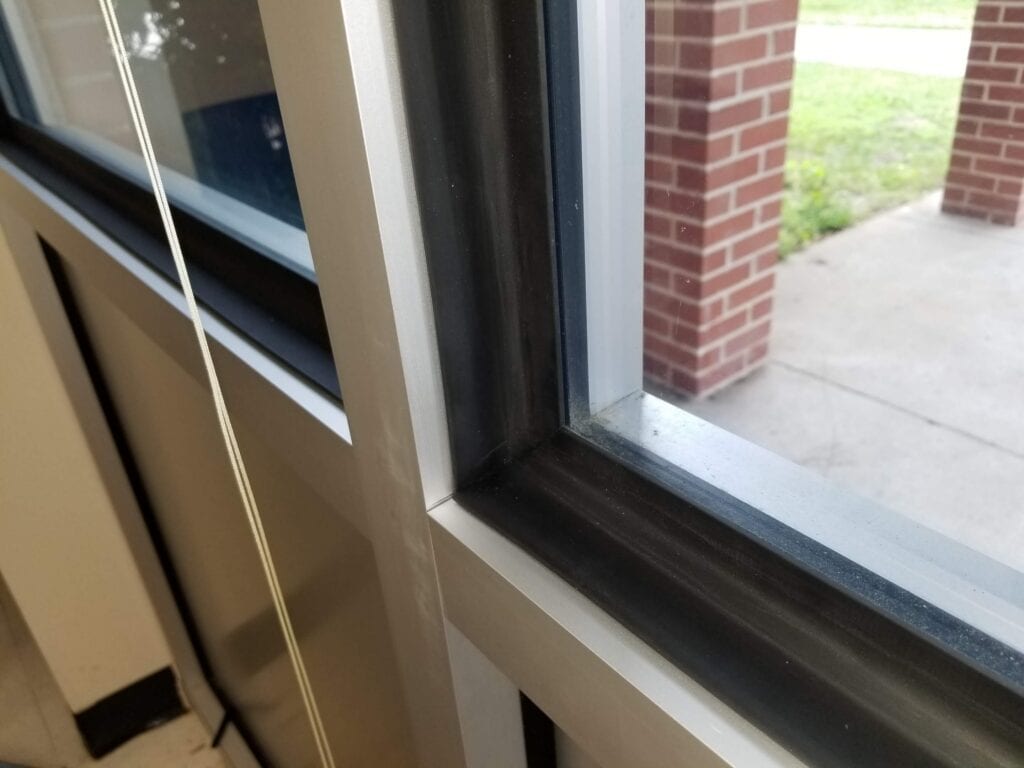
Pentagon security molding installed on school windows in Edenton, NC by Skyline Tinting LLC.
Why We Use Pentagon Protection Moldings Instead of Wet Glaze
When a frame can take an attachment, we install Pentagon Protection frame attachment moldings wherever possible rather than defaulting to a wet-glaze sealant bead.
The functional logic is the same as any anchoring system, and Pentagon Protection puts it plainly: filmed glass that is not anchored to the frame remains a hazard, because depending on the force and direction of the breakage the whole filmed sheet can either fall out of the frame or fly into the interior of the building. Anchoring is what closes that gap.
The reason we prefer the molding is the finish. A wet glaze is a hand-applied bead of structural sealant. Done well it performs, but it is caulk — and on a bright storefront or a nice room with good sightlines, a sealant bead reads as exactly what it is. Once it is cured in place, it is cured in place. A manufactured molding is an engineered profile with clean, consistent edges. It looks like trim, because it is trim. The line stays straight the whole way around the opening instead of following the steadiness of somebody’s hand at the end of a long day.
One Important Caveat on Ratings
Whether any given film-plus-attachment assembly meets a specific impact rating depends on the film, the attachment method, the glass type and thickness, and the frame. These systems are certified as complete assemblies, not as individual products. If you need a documented rating for permitting, insurance, or code compliance, we will tell you exactly what your configuration can and cannot be certified for — and if the honest answer is that you need impact glass, we will say so.
Four Options, Honestly Compared
Here is the actual decision most Hampton Roads property owners are making.
Security film exists because there is an enormous gap between “do nothing and hope” and “replace every window in the building.” Most people live in that gap.
About Virginia’s Sales Tax Holiday, August 7–9
Virginia’s three-day sales tax holiday runs Friday, August 7 through Sunday, August 9 this year, and it does include hurricane and emergency preparedness items — portable generators up to $1,000, gas-powered chainsaws up to $350, and a list of qualifying prep items at $60 or under, including tarps, plastic sheeting, batteries, flashlights, and weather radios.
To be completely straight with you: professional window film installation is not a qualifying item. We are not going to dress this article up as a tax-holiday promotion, because that would be misleading.
What we will say is this. The tarps and batteries you buy that weekend are single-purpose insurance — they sit in a closet and you hope you never open it. Window film is the rare storm-season upgrade that also works for you every single day in between. It cuts solar heat gain and cooling costs, which we broke down in our Hampton Roads home energy savings guide. It blocks the UV that destroys floors, furniture, and fabrics. And on the residential side, the energy math is good enough that we made the case in does home window tinting really pay for itself. Buy the tarps. Then think about the glass.
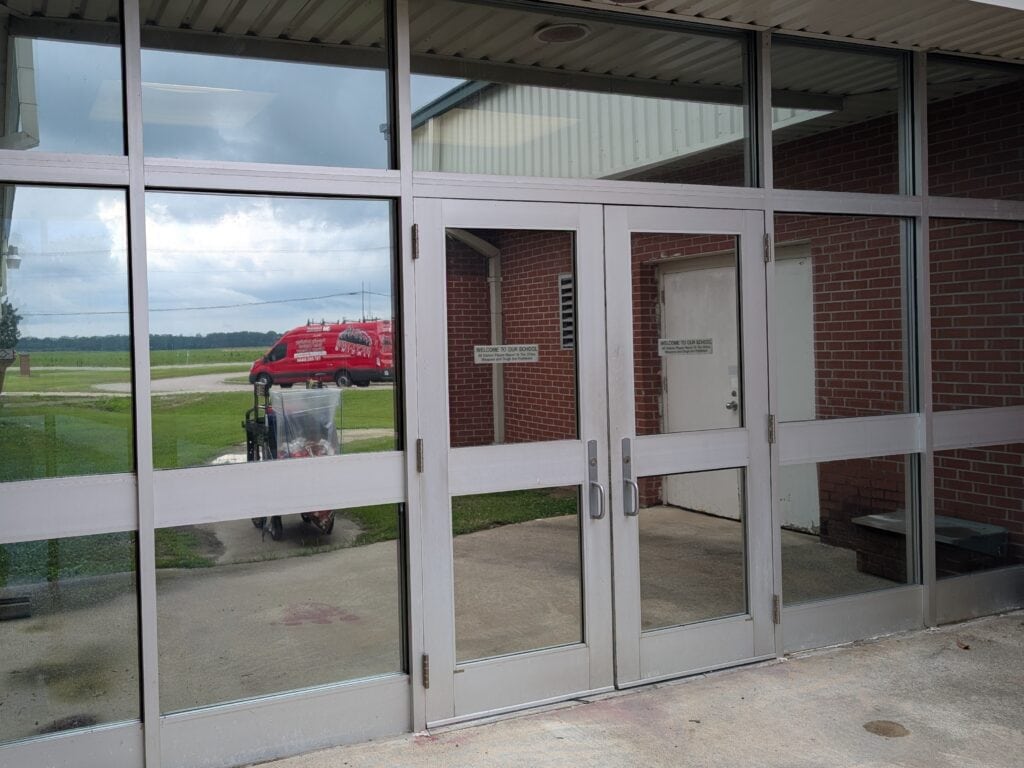
Reflective privacy security film installation with Pentagon security attachment by Skyline Tinting LLC
For Commercial Properties, the Math Is Different
If you own or manage a storefront, restaurant, medical office, or multi-tenant building in Hampton Roads, storm glass is a business continuity issue rather than a comfort issue. It is also, as covered above, where attachment systems are genuinely viable — commercial framing is what these systems were designed for.
Consider what a single breached storefront pane actually costs you. There is the glass itself, and glass replacement lead times get very long in the weeks after a regional storm event, because every glazier in the market is booked. There is emergency board-up. There is water damage to interior finishes and inventory. There is the loss of secured premises overnight. And there is closed-door revenue for every day you are not open — often the largest number on the list by far, and the one that does not appear on any insurance estimate.
Against that, filming and anchoring the storefront glass is typically a modest one-time capital expense. It is also worth asking your carrier directly whether documented safety film changes anything on your commercial property policy; some underwriters treat it as a mitigation measure and some do not, and it costs you one phone call to find out.
The operational case for commercial film extends well past storm season — we laid out the day-to-day side in three ways commercial window film can improve facility operations and in how glare might be costing you client and employee comfort. And if your property includes a vessel, the same coastal exposure applies there — marine window tinting is its own conversation.
Coastal Virginia has a specific problem: enormous amounts of ground-floor glass sitting close to open water. Storefronts along Virginia Beach’s oceanfront and Town Center, Norfolk’s Granby Street and Waterside district, Portsmouth’s High Street, and the retail corridors of Chesapeake and Newport News all combine long spans of glazing with an unobstructed fetch for wind and debris. Add the flooding and surge history of the region, and the openings that fail first are almost always the large, low, unprotected ones. Those are exactly the openings where commercial framing makes a proper attachment system practical.
Which Glass Should You Actually Prioritize?
You do not have to do the whole building at once. If budget is the constraint, protect in this order:
- Large unprotected panes on the windward exposure — typically north and east facing in a Hampton Roads storm, and any glass with an unobstructed fetch across open water.
- Ground-floor storefront and glass doors, which take the most debris, are the most likely entry point, and are the openings where attachment is most practical.
- Any glass directly above where people sleep, sit, or work. This is the injury-prevention priority, and film delivers here even without an attachment.
- Glass protecting high-value contents — inventory, equipment, records, artwork.
Most properties get the majority of the practical benefit from a minority of the openings.
What We Will Tell You When You Call
We install genuine 3M film across Chesapeake, Virginia Beach, Norfolk, Portsmouth, Suffolk, Hampton, Newport News, and the rest of Hampton Roads. If storm protection is what you are after, here is how the conversation will go.
We will look at your glass type, thickness, frame system, and exposure. We will tell you whether your frames can actually take an attachment, and if they can, we will spec a Pentagon Protection profile that fits the opening and matches the frame. We will tell you what performance you can realistically expect. If you want a documented impact rating and your configuration cannot achieve one, we will tell you that instead of selling you something that will not do what you think it does.
Some customers walk away from that conversation deciding to film and anchor everything. Some decide to film three critical openings. Some decide impact windows are what they actually need, and we are fine with that too. What we are not going to do is tell you a piece of film makes your house hurricane proof.
Frequently Asked Questions
Does window film stop a hurricane from breaking my windows?
No. Security window film does not prevent glass from breaking. It holds the broken glass together so it stays in one sheet instead of becoming flying shards, and where a proper frame attachment system can be installed, it also helps keep the pane in the opening.
Is security window film the same as hurricane impact glass?
No. Impact glazing is certified against standards such as ASTM E1886 and E1996, which include a 9-pound 2×4 fired at 50 feet per second plus cyclic pressure testing. Film applied to existing glass is a mitigation measure, not a substitute for a rated impact window.
Can frame attachment systems be installed on residential windows?
Only sometimes. Attachment systems were designed for commercial framing, which is heavier and offers a substantial surface to anchor to. Many residential windows use thin, lightweight frames with too little frame face to attach to properly, and anchoring to a frame that will itself fail under load accomplishes little. Larger openings and sliding glass doors are the most common residential candidates.
What is the difference between wet glaze and an attachment molding?
Both anchor the film edge to the window frame. A wet glaze is a hand-applied bead of structural sealant. An attachment molding is a manufactured profile that captures the film edge and fastens to the frame. We prefer Pentagon Protection moldings where the frame allows, because they produce a much cleaner, more consistent finished appearance and come in colors that match the frame.
How much does security window film cost compared to impact windows?
Filming existing glass is typically a fraction of the cost of full impact window replacement, with no permitting or construction disruption. Exact pricing depends on glass area, film grade, and whether an attachment system is included.
Does security window film qualify for Virginia’s sales tax holiday?
No. Professional installation services are not qualifying items under Virginia’s August sales tax holiday, which covers specified physical preparedness goods such as generators, tarps, batteries, and flashlights.
Get an Honest Assessment Before Peak Season
Skyline Tinting installs 3M™ Safety & Security Window Film and Pentagon Protection attachment systems for homes and businesses across Chesapeake, Virginia Beach, Norfolk, Portsmouth, Hampton, Newport News, and Suffolk. We will look at your glass, your frames, and your exposure, and tell you straight what film can and cannot do for your property.
Sources
NOAA Climate Prediction Center — 2026 Atlantic Hurricane Season Outlook
NOAA — Below-Normal 2026 Atlantic Hurricane Season Prediction
weather.com — Colorado State University July 2026 Forecast Update
ASTM E1996-23 — Windborne Debris Missile Levels
Missile Level D Explained — 9 lb 2×4 at 50 ft/second
3M™ — Impact Protection Attachment (IPA) Sealant
3M™ — Impact Protection Adhesive Attachment System
Pentagon Protection US — Flexible Anchoring Systems & Profiles
Virginia Tax — Sales Tax Holiday, August 7–9, 2026
Skyline Tinting LLC — Commercial Window Tinting in Hampton Roads