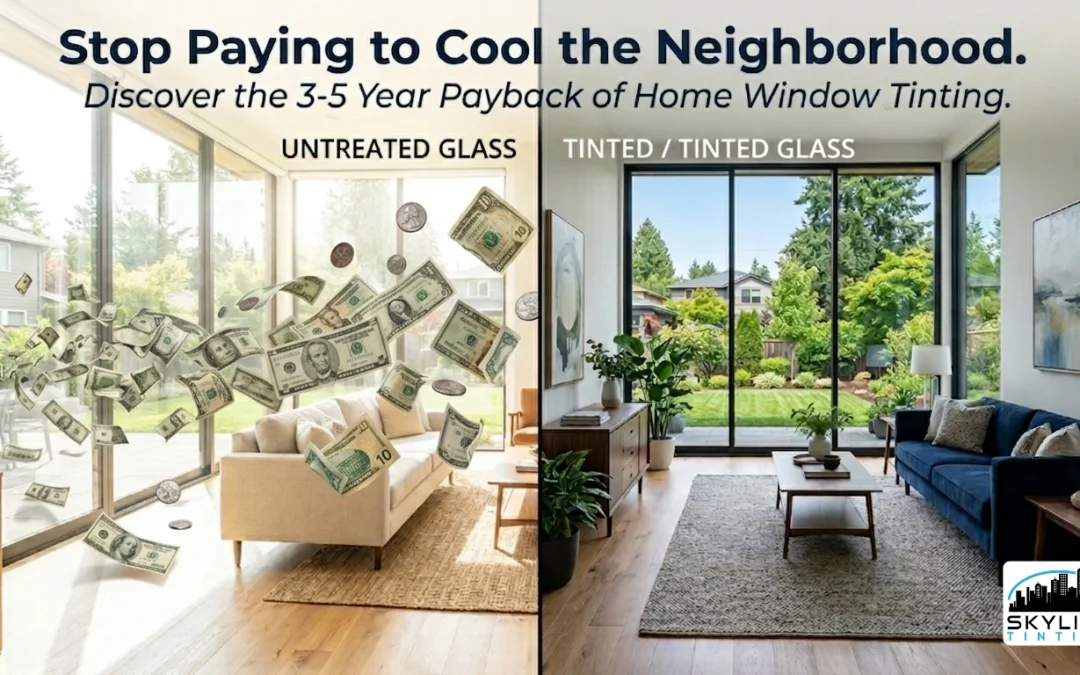
If you’ve been brushing off window tinting as a luxury upgrade, this article might change your mind. Between Virginia’s steadily rising electricity rates, longer and hotter summers, and a proven track record from the U.S. Department of Energy, residential window film has quietly become one of the smartest home investments a Hampton Roads homeowner can make.
This isn’t a sales pitch — it’s a math problem. And the math is working in your favor.
The Problem You’re Paying for Every Month: Your Windows
Most homeowners focus their energy-saving attention on insulation, HVAC tune-ups, or smart thermostats. But the biggest energy leak in your home might be staring you right in the face — literally.
In Virginia Beach, Norfolk, Chesapeake, Portsmouth, and the surrounding Hampton Roads area, where the sun beats down from late spring through early fall with intense coastal intensity, window heat gain isn’t just uncomfortable — it’s expensive.
"Up to 30% of a home's heating and cooling energy escapes through windows." — U.S. Department of Energy
That’s nearly a third of your entire energy bill potentially disappearing through untreated glass. The DOE also reports that roughly 40% of unwanted heat buildup in a home enters through the windows — not through the roof, not through the walls, but through the glass you look through every day.
Hampton Roads Is Getting Hotter — And Your AC Is Paying for It
This isn’t just a national trend. It’s happening right here in Tidewater Virginia, and the data from your own backyard backs it up.
According to NOAA climate records, the average rate of warming for the Hampton Roads / Tidewater region is approximately 1.5°F per century — and scientists note that warming has accelerated in recent decades, with overnight low temperatures rising particularly fast. Higher overnight lows mean your home never fully cools down, forcing your AC to work harder from the moment it kicks on each morning.
In July 2025, Hampton Roads experienced one of the earliest heat waves on record. A single week of extreme heat sent nearly 350 people to urgent care or emergency rooms with heat-related illness across southeastern Virginia. Dr. Natasha Dwamena of the Hampton and Peninsula Health Districts stated publicly: “It’s getting worse each year due to rising temperatures and urban heat islands.”
Federal projections are striking for the long haul. Average high daily temperatures in Hampton Roads could climb to approximately 78°F by century’s end, up from a historical average of just 68.7°F between 1960 and 1990. Virginia’s first-ever statewide climate assessment, released in late 2025, projected temperatures rising anywhere from 3°F to 13°F by 2100.
The bottom line: cooling seasons are getting longer, peak heat is getting more intense, and the urban heat island effect — all that concrete, asphalt, and dense development from Virginia Beach to Newport News — amplifies every degree.
The Coastal Factor
Hampton Roads sits at a unique intersection of high humidity, intense coastal sun, and growing urban density. High humidity makes heat feel worse, but it also means your AC runs longer to control both temperature and moisture. Every unit of solar heat blocked at the window is a unit your AC system never has to fight — directly translating to lower electricity bills.
Your Dominion Energy Bill Is Going Up — Whether You Tint or Not
Here’s the uncomfortable truth Virginia homeowners are facing right now: your electricity costs aren’t just rising with the heat. They’re rising on a regulatory calendar that has nothing to do with weather.
In late 2025, the Virginia State Corporation Commission approved a Dominion Energy rate increase that will add approximately $13 per month to the average residential bill over the next two years — phased in as an $11.24 increase in 2026 and a further $2.36 in 2027. This is Dominion’s first base rate increase since 1992.
Before the SCC ruling, Dominion had actually requested even higher increases. The original proposal would have raised the typical bill by $21.43 per month total. The approved amount was lower — but the trend is unmistakable.
Driving the long-term pressure: Virginia’s explosive data center and AI industry. A state legislative audit confirmed that the surge in demand could triple Virginia’s energy consumption if unconstrained — and that infrastructure cost will flow through to every residential customer’s bill. National retail electricity prices climbed at a 10% nominal growth rate in just the first half of 2025 alone.
When your electricity rate goes up and your cooling load goes up simultaneously, the compounding effect on your annual bill is significant. This is exactly the scenario where an upfront investment that reduces consumption starts to look less like a home improvement project — and more like a financial hedge.
"As of mid-2025, the average monthly electricity bill for a Virginia residential customer was approximately $153. With approved increases phasing in through 2027, that baseline is only moving in one direction." — Cardinal News / Virginia State Corporation Commission, 2025
What the Numbers Actually Say: The DOE’s Case for Window Film
The U.S. Department of Energy isn’t subtle about where it stands on window film. In a landmark 2011 study ranking the top 50 commercially available energy conservation technologies, window film ranked as one of the leading investments based on payback period, probability of success, and overall energy savings. That ranking hasn’t been displaced.
Here’s what the science shows:
- Up to 85% of solar heat blocked with high-performance solar film
- 99%+ of UV radiation blocked, protecting flooring, furniture, and fabrics
- 30% reduction in air conditioning costs during the cooling season (IWFA)
- 5–15% reduction in a building’s total energy bill (International Window Film Association)
- Up to 50% improvement in a window’s overall insulating performance (DOE/solar film studies)
- ~19 kWh saved per square foot of glass annually (3M / DOE analysis)
The DOE also considers window film to have one of the fastest energy-investment payback periods of any available technology — approximately three years for a standard installation. Compare that to a full window replacement, which costs 10 times more and can take a decade or longer to recover in energy savings.
Real Math for a Real Hampton Roads Home
Let’s run a straightforward cost analysis for a typical Hampton Roads home — say, a 2,000 square foot house in Chesapeake, Virginia Beach, or Norfolk with standard single or double-pane windows and a Dominion Energy account.
What Window Film Delivers
- 15–30% reduction in cooling costs during peak summer months
- If cooling represents ~50% of your summer bill ($75–$90/month May–Sept), a 20% reduction saves you $75–$90 over that five-month cooling season
- Year-round savings typically land a Hampton Roads home between $200 and $500 per year
- A 25% reduction on a $200/month bill equals $600 per year
What Window Film Costs
A typical whole-home residential installation for a Hampton Roads property ranges from approximately $750 to $3,000 depending on square footage, film type (standard solar vs. premium ceramic), and number of windows. Per-square-foot pricing is typically $5–$15 per square foot of glass professionally installed.
When Does It Pay for Itself?
At $300 in annual savings and a $1,500 installation, you break even in 5 years. At $500 in annual savings, you’re there in 3 years — consistent with the DOE benchmark. And most quality residential window films carry 10- to 20-year manufacturer warranties, meaning 7 to 17 years of pure savings after payback.
The Hidden Savings Nobody Talks About
The energy bill reduction gets all the attention, but window film generates savings in other ways that rarely appear in the headline math:
HVAC System Life Extension
Every hour your AC doesn’t run is an hour of wear it doesn’t accumulate. Reducing solar heat gain means your system cycles less frequently, runs shorter intervals, and experiences less strain during peak demand. In Hampton Roads, where HVAC units already work overtime through long, humid summers, extending the life of your system by even two or three years can represent thousands of dollars in avoided replacement costs.
Furniture, Flooring, and Interior Protection
UV exposure is the primary cause of fading in hardwood floors, carpets, furniture fabric, artwork, and window treatments. High-quality window film blocks over 99% of UV radiation — the same UV that would otherwise bleach your furniture and degrade your flooring. For a Hampton Roads homeowner who has invested in hardwood floors or quality furnishings, this protection alone can justify the installation cost.
Home Value and Energy Efficiency
As energy costs rise and buyers become increasingly focused on operational costs, homes with verified energy efficiency upgrades command stronger market positions. Window film is a visible, documentable improvement — particularly in a coastal market where energy-conscious buyers understand the solar heat load that comes with waterfront and near-water living.
One More Angle: Federal Tax Credits Still Apply
Under the federal Inflation Reduction Act’s energy efficiency provisions, homeowners may qualify for a 30% tax credit on qualifying energy-efficient home improvements, including certain window film upgrades. While specific eligibility depends on the film type, your installer, and current IRS guidance, it’s worth consulting with your tax professional — a $1,500 installation that qualifies could yield a $450 tax credit, dramatically shortening your payback period to under two years in a best-case scenario.
A third of U.S. governors have publicly recognized window film as a cost-effective energy savings solution. Consumer awareness of window film’s energy-saving properties has jumped nearly 50% over the past decade — from 54% of Americans aware of the benefit in 2014 to 79% by the early 2020s. The word is getting out.
The Bottom Line for Hampton Roads Homeowners
Window tinting isn’t a luxury for people who want darker rooms. It’s a measurable energy investment with a documented payback period, backed by federal government data, in a market where every single factor that determines your return is trending in your favor:
- Hotter, longer summers mean more solar heat gain and more AC runtime
- Rising Dominion Energy rates mean every kilowatt you don’t use is worth more than it was last year
- Coastal humidity and UV intensity amplify both heat load and interior damage
- Film installation costs are fixed — your savings grow as rates increase
- 3- to 5-year payback leaves 10–17 years of net positive returns within warranty
The question isn’t really can window tinting pay for itself in Hampton Roads. Based on the DOE data, Virginia’s rate trajectory, and our regional climate trends, the better question is: how much longer can you afford to wait?
Ready to Saving On Your Dominion Energy Bill?
Contact us for a free in-home consultation and energy savings estimate. We'll measure your glass, assess your sun exposure, and provide you with a quote for energy saving Home Window Tinting in Hampton Roads.
Give the specialists at Skyline Tinting LLC a call at 757-695-8444 or message today!
Sources: U.S. Department of Energy — residential energy loss through windows; window film energy conservation rankings (2011 Top 50 study) | International Window Film Association (IWFA) — energy savings data | 3M Window Film — per-square-foot savings, kWh data | Virginia State Corporation Commission — Dominion Energy rate case approval, Nov. 2025 | WHRO Public Media — Hampton Roads heat wave, July 2025 | 13NewsNow / NOAA — Tidewater temperature data | WRIC ABC 8News — Virginia Climate Assessment, Nov. 2025 | Cardinal News — Dominion rate increase, 2025 | American Action Forum — Virginia electricity analysis, 2026