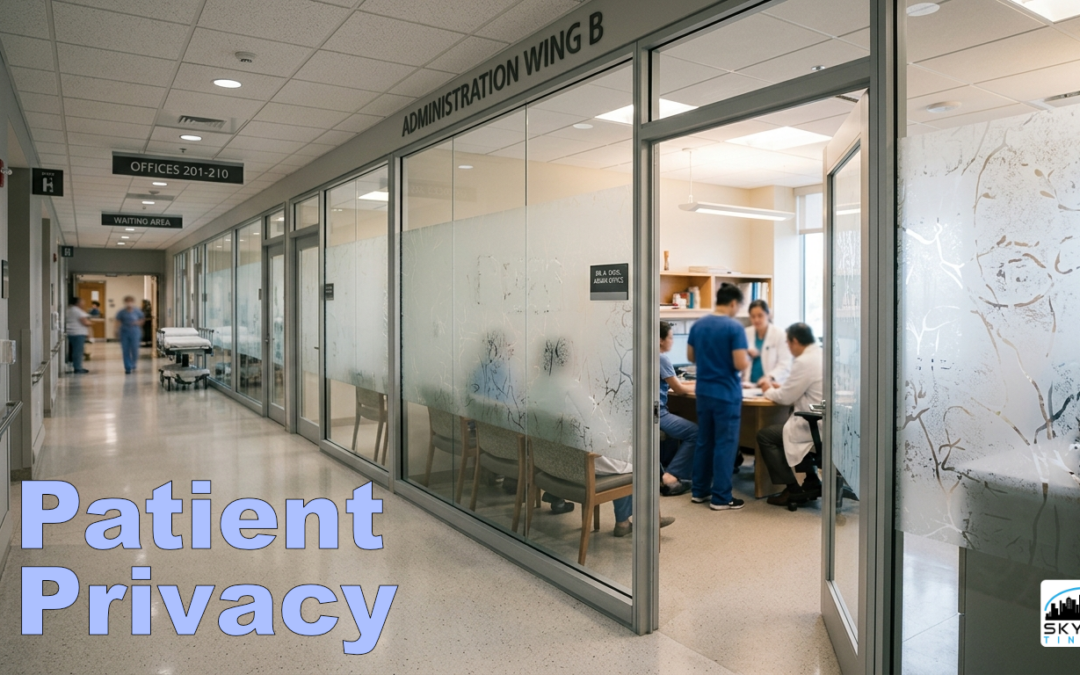
Walk into almost any hospital or outpatient clinic built in the last decade — whether it’s a Sentara campus in Norfolk, Chesapeake Regional, or a Bon Secours medical office down in Suffolk — and you’ll notice something that wasn’t there a generation ago: glass. Lots of it. Open, light-filled lobbies, glass-walled waiting areas, and transparent clinic partitions have become the signature of modern healthcare design. The intent is good: warmer, calmer, more human spaces that feel less like an institution.
But all that transparency creates a problem. Healthcare is, by its very nature, deeply private — and federal law treats it that way. The moment a patient’s name, diagnosis, or face can be seen by someone who shouldn’t see it, a facility has a potential compliance issue on its hands. The fix is often hiding in plain sight, right there on the glass: professional privacy window film.
“Reasonable safeguards against incidental disclosure aren’t optional under HIPAA — and in a building made of glass, the safeguard is often the glass treatment itself.”
Industry Research & Field Documentation
Privacy film for healthcare settings generally falls into three categories. Each meets the same compliance goal — blocking unauthorized sightlines to protected health information — but they do it with very different looks and budgets.
Sources: U.S. Dept. of Health & Human Services — HIPAA; HHS Office for Civil Rights guidance on incidental disclosure.
What HIPAA Actually Requires of a Physical Space
Most people connect HIPAA with electronic records, passwords, and paperwork. Fewer realize the law reaches into the physical environment as well. The HIPAA Privacy Rule requires covered entities to put “reasonable safeguards” in place to protect patients’ protected health information (PHI) from incidental disclosure. It doesn’t dictate specific building features — instead, it requires each organization to look at its own space and reduce the risks it finds.
The HHS Office for Civil Rights has been clear that visible patient information can count as incidental disclosure when reasonable precautions aren’t taken: a name on a whiteboard, a chart left on a desk, a patient visible through a glass wall during treatment. So the practical question for any facility manager becomes simple. Can someone standing in a public corridor, lobby, or waiting room see something they shouldn’t? In a building full of glass partitions and reception glass, the honest answer is usually yes — until something is done about it.
Hampton Roads is a dense, fast-growing healthcare market — Sentara, Bon Secours, Chesapeake Regional, the VA Medical Center, and CHKD all operate multi-building campuses and satellite clinics across Norfolk, Virginia Beach, Chesapeake, Portsmouth, and Suffolk. Many of these facilities were built or renovated around open, glass-forward designs. That makes privacy film one of the most cost-effective compliance upgrades a regional facility manager can make — no construction, no downtime, applied right over the existing glass.
Frosted Film: The Workhorse of Clinical Privacy
The most common and recognizable solution is frosted decorative film. It transforms clear glass into a translucent surface that diffuses daylight while blocking direct visual access. Applied to the glass walls and entry doors of clinical suites, it keeps natural light flowing through the space — preserving that open, airy feel modern design strives for — while making sure patients seated in waiting areas or positioned near exam rooms can’t be seen or identified from a public hallway.
It’s especially well suited to the glass vestibule entries common in specialty clinics. From the outside, the frosted surface reads soft and professional. From the inside, staff and patients keep a sense of enclosure. Critically, the film doesn’t block emergency egress signage or fire-code visibility — EXIT signs stay clearly visible overhead — and it goes onto virtually any glass surface with no structural modification at all.
The benefits go beyond HIPAA, too. Frosted film cuts glare on the reception screens that display electronic PHI. It limits visibility of paper intake forms and insurance documents patients fill out while seated. And it eases the quiet social discomfort patients feel when they know they’re on display to everyone walking past — a small but real contribution to the patient experience.
Decorative Film: Privacy That Doubles as Art
Not all privacy film has to look clinical. Decorative film — think organic branch-and-twig motifs, frosted gradients, or geometric patterns — serves the exact same privacy function while actively contributing to a healing environment. From a distance it can look like an art installation or specialty glazing; in reality it’s a privacy film applied to ordinary glass. The figures and objects behind it become completely indistinguishable, while the space gains warmth and texture.
This reflects a broader truth in healthcare design: the physical environment shapes patient wellbeing, anxiety, and even outcomes. Nature-based imagery in particular has been shown across multiple studies to lower stress in clinical settings. A window treatment that achieves HIPAA compliance and provides calming visual interest is a genuine two-for-one. Patients waiting for an appointment — often anxious, often in pain — are far better served by thoughtful design than by institutional blankness.
Custom & Branded Film: Identity Meets Compliance
The third category is branded or custom-printed film. A system shield, a clinic wordmark, or a department name applied directly to frosted entry panels does double duty: it reinforces institutional identity and wayfinding while contributing the same privacy protection as plain frosted film. For patients navigating a sprawling, multi-specialty campus, clear branding at clinic entry points helps them find their destination with confidence — and the film essentially becomes signage with no extra wall-mounted hardware.
Custom film can also carry patient-education content, wayfinding, or calming messaging in transitional spaces. Some systems use large-format custom graphics to turn otherwise blank pediatric corridors into engaging, anxiety-reducing environments for young patients and their families — all while covering the same surface area and delivering identical privacy.
For Hampton Roads practices managing several locations, custom-branded frosted film is a smart way to standardize a professional look across every site while checking the privacy box at the same time. Skyline Tinting works directly with commercial property managers and facility teams in Chesapeake, Norfolk, Virginia Beach, Portsmouth, and Suffolk to spec, print, and install film that matches your brand and your compliance plan.
Implementation Considerations for Healthcare Facilities
Choosing and installing privacy film in a medical setting takes more than picking a pattern. A few factors matter a great deal:
Coverage height. HIPAA-relevant exposure often happens at seated height — a patient in a wheelchair or waiting-room chair can be more visible at lower sightlines than a standing person. Film should generally cover the full glass panel from floor to top rail, not just the upper or lower portion.
Maintenance and durability. Clinical environments get cleaned constantly with hospital-grade disinfectants. Commercial- and healthcare-rated films are built to withstand repeated chemical cleaning without delaminating, discoloring, or peeling. Cheap residential-grade product is simply the wrong tool here.
Documentation. When an organization runs its periodic HIPAA risk assessment, the physical safeguards in place — including window treatments — should be inventoried and noted. That record demonstrates a good-faith effort to address incidental-disclosure risk.
- Patients visible and identifiable from public hallways
- Reception screens and intake forms exposed to onlookers
- Glare washing out PHI on staff monitors
- Incidental disclosure risk on every glass surface
- Cold, institutional feel in waiting areas
- Treatment areas fully obscured from public view
- Check-in screens and paperwork shielded
- Reduced screen glare protects electronic PHI
- Documented physical safeguard for HIPAA records
- Natural light preserved with a warmer, calmer feel
“Window film is powerful, but it works best as one layer in a comprehensive approach — paired with acoustic privacy at check-in, smart space planning, and staff training on what incidental disclosure really means.”
The Bottom Line
The shift toward glass, openness, and natural light in healthcare design is a genuinely good thing — for patients, for staff, and for the communities these facilities serve. Privacy window film makes it possible to chase that vision without sacrificing the confidentiality patients are legally entitled to and deeply deserve. Frosted, decorative, or custom-branded, these films are a practical, elegant, and often beautiful answer to one of modern healthcare architecture’s central tensions. In a well-designed clinic, compliance and care end up woven together — right there in the glass.
Contact the Skyline Tinting commercial window tinting professionals at 757-695-8444. We install frosted, decorative, and custom-branded privacy films for hospitals, clinics, and medical offices across Chesapeake, Norfolk, Virginia Beach, Portsmouth, Suffolk, and the rest of Hampton Roads. Schedule a free on-site assessment and we’ll walk your space, flag exposed sightlines, and recommend the right film — no construction, no downtime.
Sources:
U.S. Department of Health & Human Services — HIPAA Home
HHS Office for Civil Rights — HIPAA Privacy Rule
HHS — Incidental Uses and Disclosures Guidance
Skyline Tinting LLC — Commercial & Decorative Window Film Services in Hampton Roads