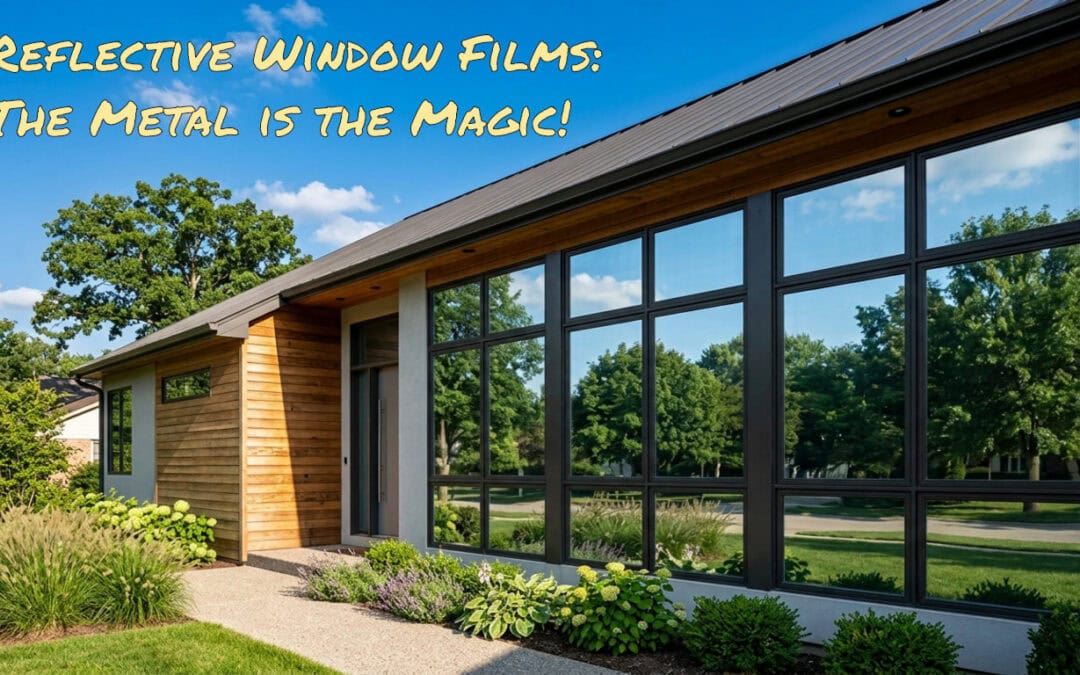
Walk into virtually any sunroom in our coastal Virginia area at 4 p.m. in July, you already understand the problem. The glass looks clean and clear, the AC is running hard, and the room still feels like the inside of a parked car. Out here in Hampton Roads, where the afternoon sun bounces off the Bay and the Elizabeth River and pours straight through west-facing windows, the heat coming through your glass is not really about brightness at all. It is about infrared energy — and the single best material on earth for stopping it happens to be metal.
This is the story of why reflective (metalized) window film remains the most efficient, most cost-effective heat-rejection technology a homeowner or business owner can put on their glass — and why “reflect it” beats “soak it up” every time the sun comes out.
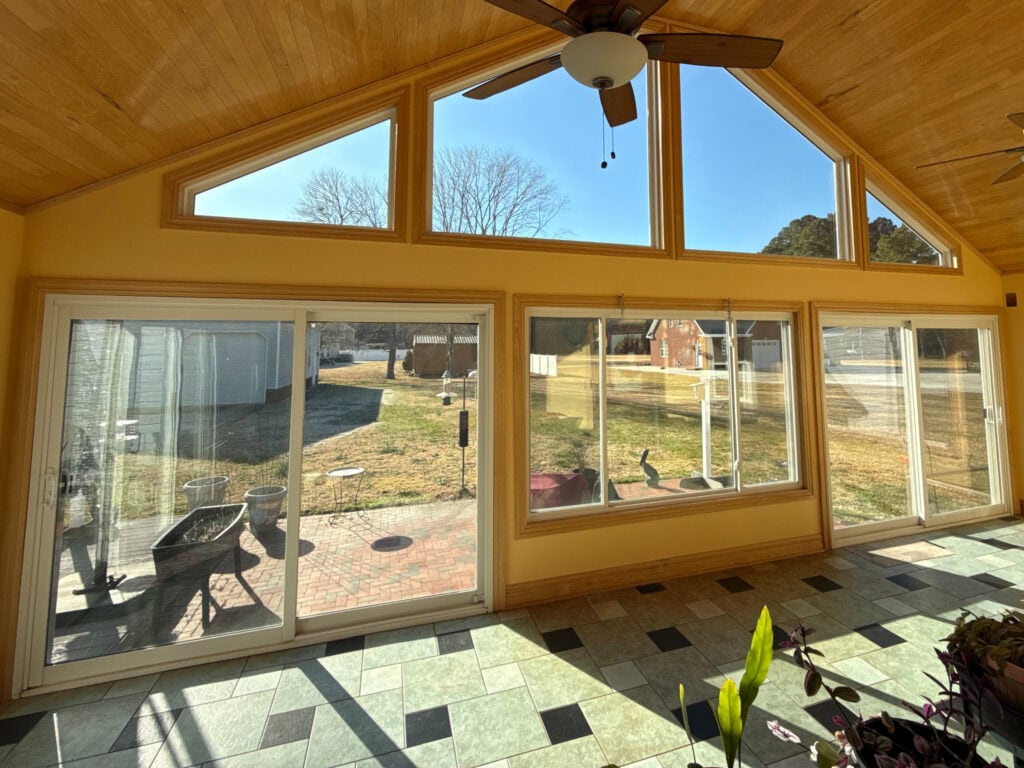
Untreated glass like this lets the sun’s infrared heat pour straight in — exactly the afternoon glare and heat buildup reflective window film stops at the source.
What this guide covers
1
Where window heat actually comes from — and why your eyes can’t see it
2
The two ways film fights heat: reflect it, or absorb it
3
Why metal is the undisputed champion at stopping infrared
4
How dyed, ceramic, and metalized films really compare
5
What this means for Hampton Roads homes and businesses
The heat you feel isn’t the light you see
Sunlight is a package deal. A small slice of it is ultraviolet (the part that fades your floors and furniture), a chunk is the visible light your eyes use, and more than half of the sun’s energy arrives as infrared — the invisible wavelength that turns into heat the instant it hits something solid.
That is the whole game. When near-infrared energy passes through your window glass and strikes your couch, your floor, your countertop, or you, it converts to heat and gets trapped inside. Your AC then spends the rest of the afternoon fighting energy that walked in for free. Stop the infrared at the glass, and you stop the heat before it ever becomes your problem.
“Controlling window heat isn’t about making a room darker. It’s about stopping the one invisible wavelength — infrared — that carries the heat.”
Two strategies: reflect the heat, or absorb the heat
Every heat-control window film on the market does its job one of two ways, and the difference matters more than any marketing brochure lets on:
Absorb it. Dyed films and ceramic films work mostly by soaking up solar energy inside the film itself. The trouble is basic physics: a material that absorbs heat then has to get rid of it, and it re-radiates that energy in both directions — some back outside, but some straight into your room. The film and glass heat up, and a share of the energy you were trying to block ends up indoors anyway.
Reflect it. A reflective (metalized) film does something fundamentally smarter: it bounces infrared back outside before it can enter the glass at all. Energy that never gets absorbed never has to be re-radiated, so it never has the chance to become indoor heat. This is the same principle the U.S. Department of Energy points to when it notes that silver, mirror-like reflective films are typically more effective at cutting solar heat than colored, absorptive ones.
Reflection is simply the cleaner thermodynamic move. And that raises the obvious question: what material reflects infrared best?
Why metal wins — it isn’t even close
Metals are nature’s mirrors for heat. Their free-moving electrons make them extraordinarily good at reflecting infrared radiation rather than letting it pass through — which is exactly why metal gets used everywhere heat needs to be controlled. It’s the reason a foil emergency blanket can keep a person warm with a layer thinner than plastic wrap. It’s the reason high-performance “low-E” glass relies on a micro-thin metallic coating to bounce radiant heat. And it’s the reason a metalized window film can knock a window’s emissivity — its tendency to pass radiant heat — down to as low as 0.04. On a 0-to-1 scale, that is about as close to “heat doesn’t get through” as physics allows.
Here’s the part that makes it a genuine value play: the metal doing all this work is applied in a layer measured in nanometers, and the base metals used — aluminum chief among them — are among the cheapest, most abundant raw materials on the planet. You are paying for an almost invisibly thin coating of an inexpensive metal that happens to be the best infrared reflector we know of. That combination — elite performance from a low-cost material — is why reflective film delivers some of the most heat rejection per dollar in the entire industry.

Dyed vs. ceramic vs. metalized: an honest breakdown
There are three families of heat-control film. Here’s where each one really lands — no spin.
Dyed film is the budget option. It tints the glass and absorbs some light, but it does little for infrared, it heats up, and the dye fades and discolors over a few years of Tidewater sun. It’s the weakest performer on heat, full stop.
Ceramic film is a genuinely good product, and we install plenty of it. It uses non-metallic nano-ceramic particles to block infrared, it never interferes with cell or GPS signals, and it stays neutral and clear. For clients who want zero exterior sheen and no signal questions, it’s an excellent choice. Its mechanism, though, still leans on absorption — which is why premium ceramic carries a premium price to reach the heat numbers that metal hits naturally.
Metalized / reflective film is the efficiency champion. Because it reflects infrared instead of absorbing it, and because metal is the best reflector there is, it delivers top-tier heat rejection — and it does it using an inexpensive raw material, which is why it consistently offers the strongest heat-rejection-per-dollar of the three. For west-facing glass, big commercial storefronts, and anywhere the sun is relentless, it’s hard to beat.
What untreated glass quietly costs you
🔥 Higher energy bills
Windows can account for up to a quarter or more of a building’s heating and cooling costs. Every BTU of infrared you let in is a BTU your AC has to remove.
🌡 Uneven, uncomfortable rooms
West- and east-facing rooms turn into hot boxes in the afternoon while the rest of the house stays fine — a comfort gap film fixes at the source.
📷 Faded floors & furnishings
UV and solar heat bleach hardwood, carpet, fabric, and artwork. Once it’s faded, it’s gone — reflective film blocks the cause.
💻 Glare on every screen
In offices and storefronts, glare kills productivity and hides merchandise. Cutting solar energy cuts the glare with it.
⚓ Why this matters even more in Hampton Roads
Our corner of Virginia is a perfect storm for solar heat gain. The cooling season runs long — roughly April into October — and the humidity makes the AC work even harder to keep up. On top of that, all that water is working against you: sunlight reflecting off the Chesapeake Bay, the Elizabeth and Lafayette Rivers, and the Intracoastal hits waterfront and water-view glass from extra angles all afternoon.
From water-view homes in Virginia Beach and the West Neck and Sandbridge areas, to sun-blasted storefronts along Battlefield Boulevard in Chesapeake and Greenbrier’s commercial strips, to office glass in Downtown Norfolk — reflective film earns its keep here in a way it simply can’t in milder, cloudier climates.
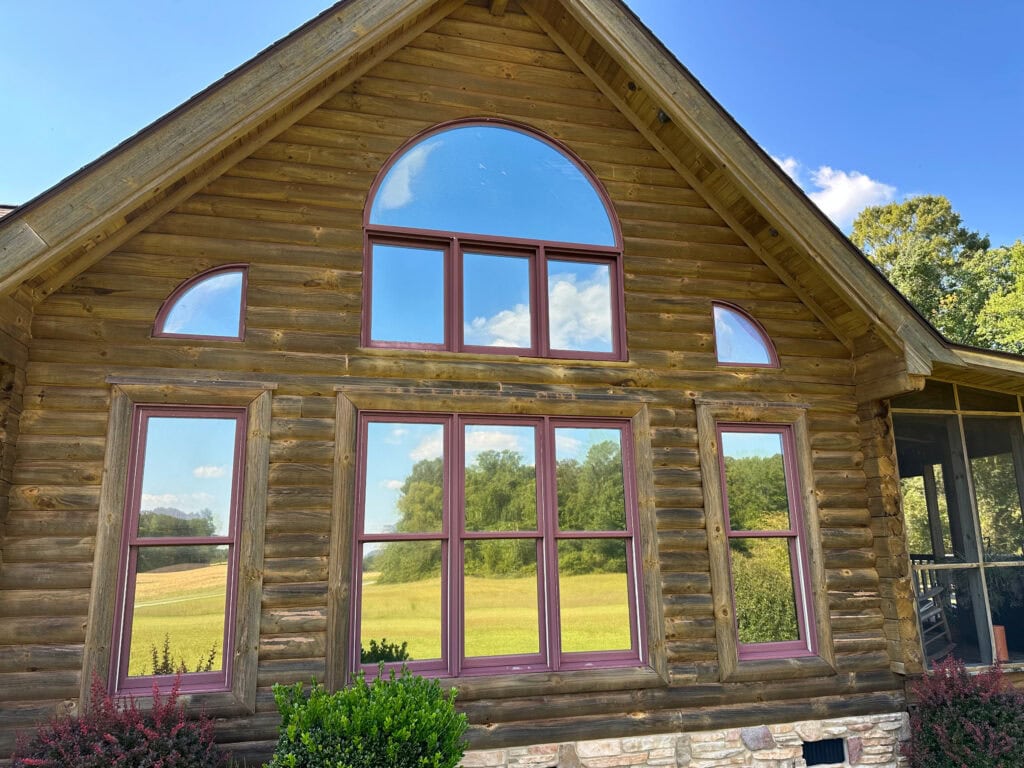
Reflective window film installed by Skyline Tinting — the mirrored finish is the film rejecting solar heat and glare before it reaches the glass, on a log home here in Hampton Roads.
One fair caveat — and how we handle it
The classic knock on metalized film is that older reflective products could look mirror-like from outside and, in some cases, dampen a cell or GPS signal. That reputation came from first-generation films. Today’s reflective and dual-reflective films are engineered to be far more neutral from the street, and we’ll walk you through the exact look and performance of each option before anything touches your glass. If signal sensitivity or a completely sheen-free exterior is your top priority, we’ll tell you straight and may point you toward a ceramic or spectrally-selective option instead. The goal is the right film for your windows — not a one-size-fits-all pitch.
Tame the Hampton Roads sun — at the glass
Skyline Tinting is a 3M Authorized Window Film Dealer serving Chesapeake, Virginia Beach, Norfolk, Portsmouth, Suffolk, Hampton, and Newport News. Tell us about your hottest windows — residential or commercial — and we’ll recommend the film that gives you the most heat rejection for your money.
Sources
- U.S. Department of Energy — Energy Efficient Window Coverings (reflective films and near-IR solar control). energy.gov
- U.S. DOE / Oak Ridge field study — Low-Emissivity, Energy-Control Retrofit Window Film (5–15% building electricity savings; metallic low-E coatings and reflectivity). osti.gov
- International Window Film Association (IWFA) — solar-control film cooling-cost reduction (up to ~30%).
- National Renewable Energy Laboratory (NREL) — window-film impact on Solar Heat Gain Coefficient in hot climates. docs.nrel.gov
- 3M — Low-E / Thinsulate Climate Control window film technical overview (metallized coatings reflect radiant heat). 3M Low-E films