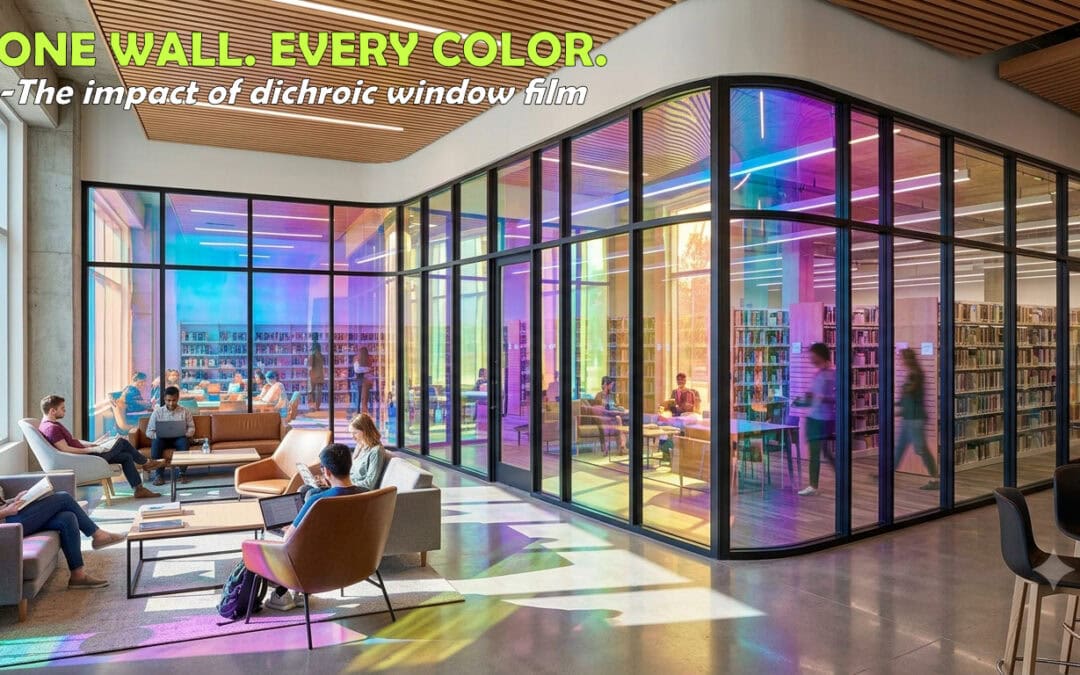
Some window films are meant to disappear. Dichroic film does the opposite — it turns an ordinary sheet of clear glass into a shifting, shimmering ribbon of color that changes as you walk past it. One moment a storefront reads amber and gold; a few steps later the same glass glows blue and magenta. Nothing about the glass has changed. Only your angle has. That single quality is why architects, retailers, and brands keep reaching for dichroic film when they want a space to stop people in their tracks.
At Skyline Tinting, we install decorative and specialty film for businesses across Virginia Beach, Norfolk, Chesapeake, Portsmouth, Hampton, Newport News, and Suffolk. As a 3M Authorized Window Film Dealer, we work with 3M™ Dichroic Glass Finishes — the same color-shifting effect used in high-profile architectural projects, achieved with film on your existing glass rather than a full glazing replacement. Here is how it works, why it looks the way it does, and how a business can use it to add a splash of color to plain, forgettable glass.
Industry Research & Product Documentation
The color you see in dichroic film comes from the structure of the film itself, not from any dye or pigment — the same optical principle that makes a butterfly’s wing, a soap bubble, or a film of oil on water flash with color. Because there is no pigment to fade, the effect does not wash out over time the way tinted gels or colored plastics can.
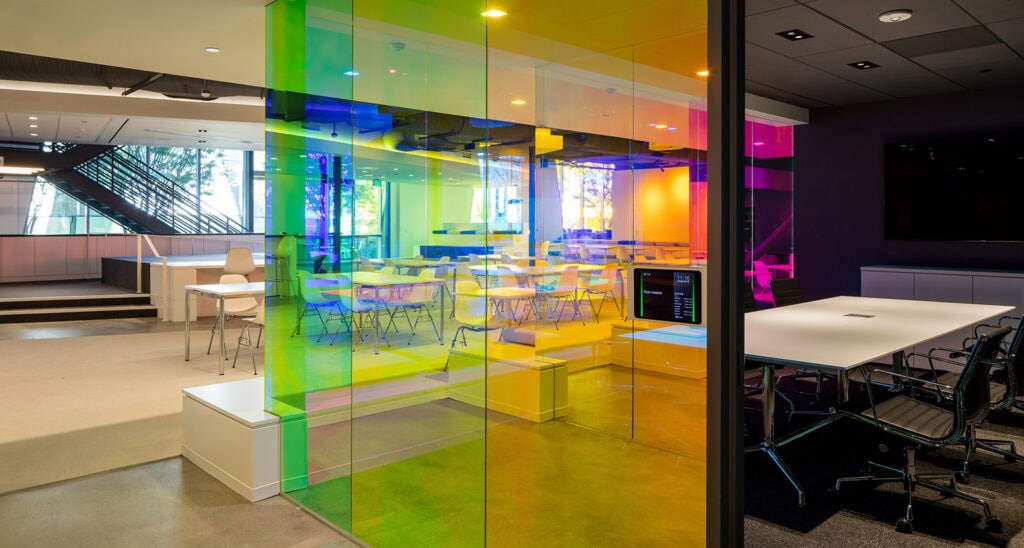
A dichroic film partition wraps a conference room in shifting rainbow color, turning a plain glass wall into a design centerpiece.
Dichroic Film at a Glance
Sources: 3M™ Dichroic Glass Finish DF-PA Product Bulletin; Glass Magazine, “Dichroic Glass and How It Works”; Energy Products Distribution product data.
What Dichroic Film Actually Is
The word dichroic comes from Greek — di for two and chroma for color. It describes a material that shows one color when light passes through it and a different, complementary color when light reflects off it. Look at a dichroic-filmed door from the sidewalk and it might read gold; stand behind it looking out and the same glass reads blue. Both colors are always present. Which one you see depends entirely on where you and the light happen to be standing.
The effect first became widely known through NASA’s space-age coating research, which was developed to shield equipment and astronauts from unfiltered sunlight. Those same thin-film coating techniques were later adapted for decorative glass and, eventually, for adhesive-backed film that installs on glass you already own. 3M™ Dichroic Glass Finishes bring that technology to a peel-and-apply film measured in thousandths of an inch.
How Dichroic Film Is Made
Here is the part that surprises most people: there is no colored ink anywhere in dichroic film. The color is an optical effect produced by the film’s physical structure — a phenomenon called thin-film interference.
The film is built by stacking many ultra-thin transparent layers on a clear polyester base. Each layer has a slightly different refractive index — a measure of how much it bends light. When daylight hits the stack, part of the light reflects off the top of each layer and part continues to the next. Those reflected light waves then overlap. For certain colors, the waves line up and reinforce each other (constructive interference), making that color appear vivid and bright. For other colors, the waves cancel out (destructive interference) and pass straight through the glass instead. The result is a surface that reflects one band of color while transmitting its complement.
By precisely controlling the thickness and number of those layers, manufacturers tune exactly which colors the film reflects and which it lets through. It is the same mechanism nature uses to color a peacock feather or a beetle’s shell — structural color, not pigment — which is why the effect stays saturated instead of fading.
3M’s architectural version, the DF-PA series, is a hard-coated, PVC-free polyester film roughly 1.3 mil thick with a clear pressure-sensitive adhesive. It carries a Class A fire rating and is designed for interior flat glass surfaces. It comes in two families — Blaze and Chill — which we’ll break down below.
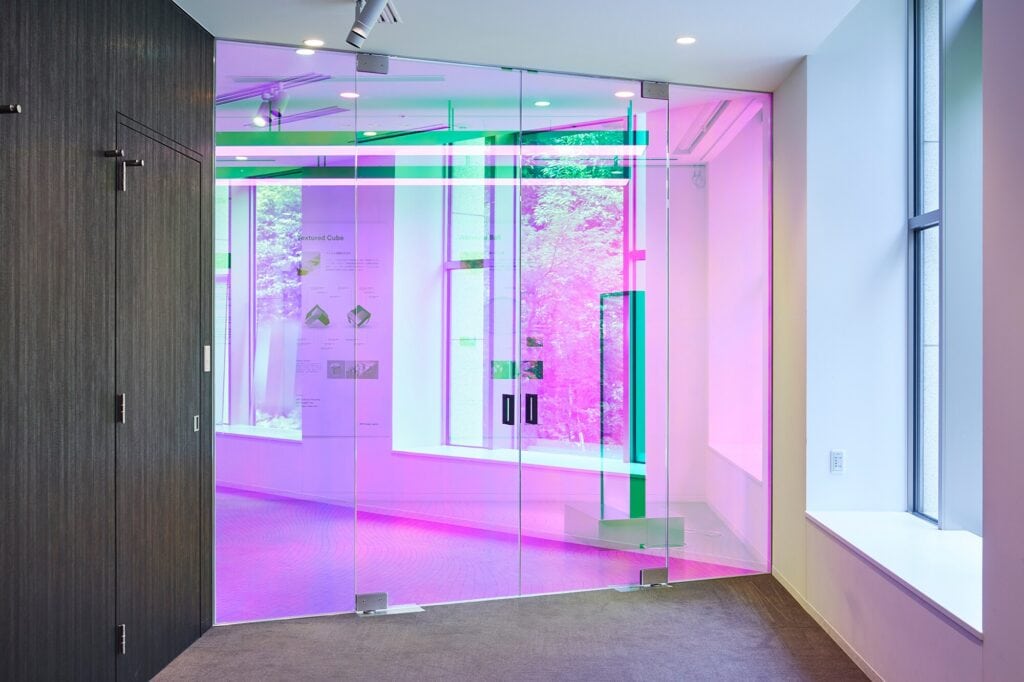
Dichroic film turns a standard glass entry into a color-shifting showpiece — magenta from one angle, green from the next.
Why the Color Shifts as You Move
The reason dichroic film feels almost alive is that its color depends on three things working together, all of which change constantly through a normal day:
Your viewing angle. When you look at the film straight on, light travels one distance through the layers. When you look at it from the side, that path lengthens, which shifts which color waves reinforce. Walk past a dichroic panel and you literally watch the hue travel with you.
The angle of the light. Morning sun, high noon, and a low golden-hour glow each strike the glass differently. A storefront can read cool blue at 9 a.m. and warm copper by late afternoon, then change again under interior lighting after dark.
The surface behind it. Because the film also picks up the color and tone of whatever sits behind the glass, the same film reads differently over a dark wall, an open interior, or a bright window. This is why a physical mock-up on your actual glass matters — the effect is genuinely site-specific.
Blaze vs. Chill: Choosing Your Palette
3M™ Dichroic Glass Finishes come in two tone families, and the right one depends on the mood you want and the colors already in your brand and space.
Blaze (warm tones) shifts through cyan, blue, and magenta when light passes through it, and glows in red and gold ranges in reflection. It reads energetic and rich — a strong fit for restaurants, bars, boutiques, and brands that lean warm.
Chill (cool tones) transitions through blue, magenta, and yellow in transmission, and through gold, green, and blue in reflection. It reads clean, modern, and calming — a natural choice for tech offices, med spas, salons, showrooms, and coastal-inspired interiors.
How Businesses Use It to Grab Attention
Clear glass is invisible — and for a business, invisible glass is a missed opportunity. Dichroic film turns that same glass into a moving, memorable feature. Here are four of the most effective ways businesses put it to work:
On busy corridors like Virginia Beach Town Center, Norfolk’s Granby Street and NEON District, or the retail strips of Chesapeake and Newport News, standing out is everything. A restaurant, brewery, boutique, salon, med spa, or showroom with a dichroic-filmed entry or feature wall reads completely differently from the clear-glass neighbors on either side — and in our long, bright coastal daylight, that shifting color is on display from open to close. Because we apply the film to your existing storefront or interior glass, it’s a same-glass upgrade rather than a costly glazing replacement.
Clear Glass vs. Dichroic Film
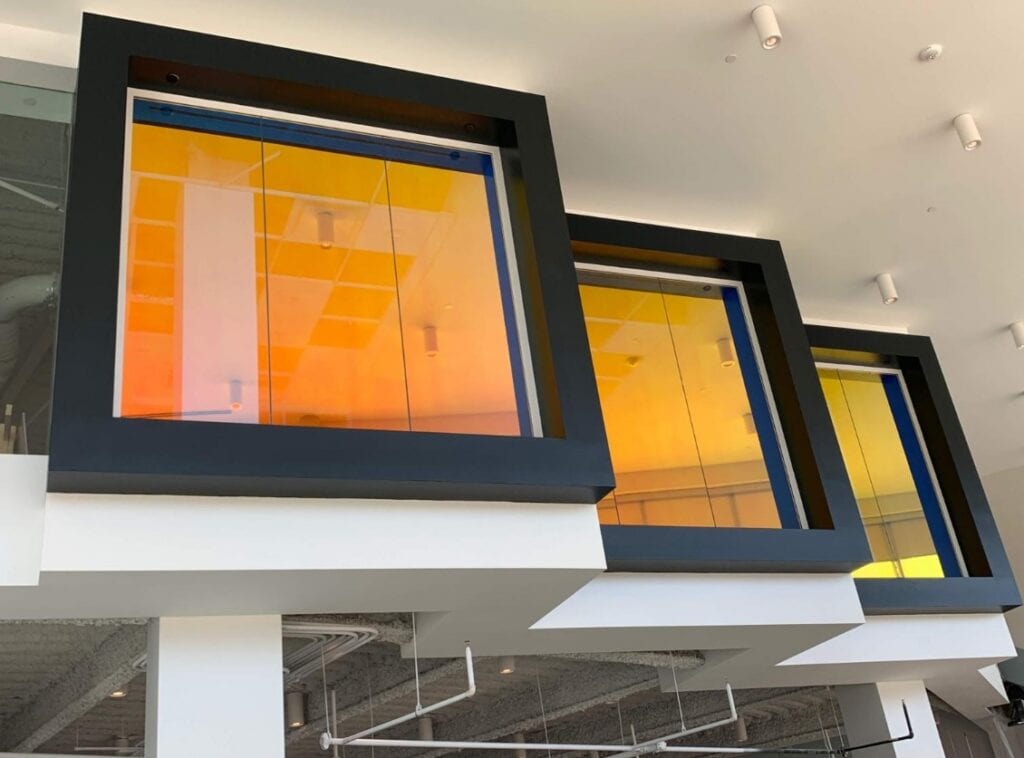
Framed dichroic panels glow amber and gold overhead, their color shifting with the light and your position in the room.
Dichroic in the Real World: Architectural Projects
Dichroic glass and film have moved from a niche art material into some of the most talked-about buildings and installations in the world. If you want to see what’s possible before committing to your own space, these architecture and design publications have documented standout projects:
Architizer — “Kaleidoscopic: 7 Mesmerizing Dichroic Glass Structures.” A tour of landmark dichroic projects, including Reykjavik’s Harpa Concert Hall (using Schott’s NARIMA dichroic glass, which ranges from warm lava gold to glacier blue), the FULTON – A5A1 residential building on the Seine in Paris with iridescent dichroic balconies, and SOFTlab’s Nova pavilion at New York City’s Flatiron plaza, built with 3M Dichroic Film. It also covers an early large-scale project by Ross Barney Architects featuring 177 color-shifting dichroic fins.
Interior Architects (IA) — “Dichroic Glass Creates an Effect.” A portfolio of workplace interiors using dichroic glass, including a two-story dichroic wall in the Tencent lobby and a shifting red-to-blue reception wall for fintech company Carta — one project in the collection earned an Interior Design magazine Best of Year award.
Dezeen — Coloured Glass Architecture & Design. Dutch architecture firm OMA has updated the Saks Fifth Avenue department store in Manhattan with a glass escalator that appears multicolored from different angles.
Glass Magazine — “Dichroic Glass and How It Works.” A trade-publication deep dive into the material science and architectural applications, useful if you want to understand the engineering behind the effect before specifying it.
The takeaway from every one of these projects is the same: dichroic isn’t just a color, it’s an experience that changes with the light and the viewer. And thanks to 3M film, you don’t need a landmark building budget to bring that experience to your own storefront or lobby.
Add a Splash of Color to Your Glass
Skyline Tinting installs 3M™ Dichroic Glass Finishes for businesses across Chesapeake, Virginia Beach, Norfolk, Portsmouth, Hampton, Newport News, and Suffolk. We’ll help you choose Blaze or Chill, mock it up on your actual glass, and turn a plain window into the thing people can’t stop looking at. Reach out for a consultation.
Sources
3M™ Dichroic Glass Finish DF-PA — Product Bulletin
Glass Magazine — Dichroic Glass and How It Works
Architizer — Kaleidoscopic: 7 Mesmerizing Dichroic Glass Structures
Interior Architects (IA) — Dichroic Glass Creates an Effect
Dezeen — Colored Glass Architecture & Design
Energy Products Distribution — 3M Dichroic Glass Finishes
Skyline Tinting LLC — Commercial & Decorative Window Film in Hampton Roads