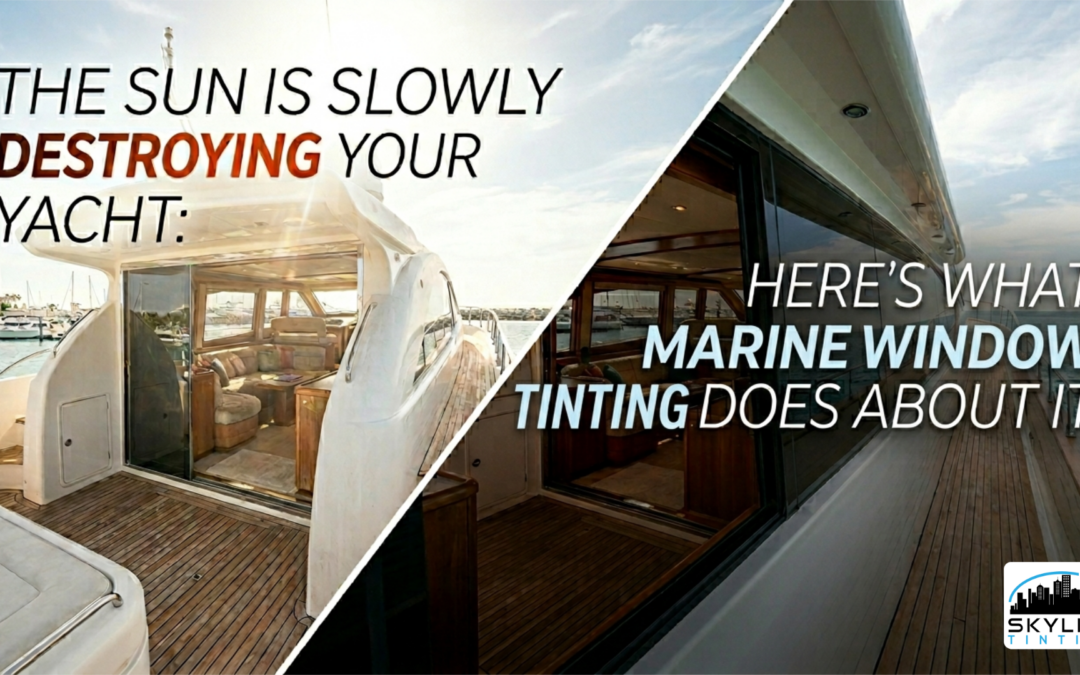
You didn’t invest in a yacht to watch it fall apart. But every hour your vessel sits in Hampton Roads sun — tied up at the dock in Chesapeake, anchored off Portsmouth, or making a run out through the Great Bridge locks toward the Bay — the sun is working against you. UV and infrared radiation are quietly attacking your teak, bleaching your gelcoat, destroying your upholstery, and overwhelming the air conditioning systems you depend on for comfort.
The damage is silent, cumulative, and expensive. And unlike engine maintenance or hull cleaning, most yacht owners never see it coming until the bill arrives. One proven solution addresses all of it: professional marine window tinting. Here’s exactly what the sun is doing to your most valuable surfaces — and what high-performance window film can do to stop it.
“Ultraviolet rays & Infrared rays are slowly bleaching away the colors and making materials brittle. Extend the life of the woods, leathers, upholstery & furniture by reducing daily solar damage.”
What UV Radiation Actually Does to a Yacht’s Interior
The sun emits two primary forms of radiation that damage boat interiors: ultraviolet (UV) rays and infrared (IR) rays. UV rays are the high-energy photons that break down molecular bonds in wood fibers, gelcoat resin, fabric dyes, and vinyl compounds — the same radiation that causes sunburn on your skin. Infrared rays carry the sun’s heat energy, driving up cabin temperatures and compounding the UV damage by drying out materials faster than they can naturally recover.
Unprotected cabin windows allow up to 100% of both UV and IR to pass directly into the cabin — concentrating that energy on every surface inside. Here’s how that plays out across the four most vulnerable and costly areas of any yacht.
Marine Industry Research & Field Documentation
The Four Threats Working Against Your Yacht Every Day
Sources: Skyline Tinting LLC | Chic Marine | Sea-Cool Marine Films
The Four Threats to Your Yacht’s Value — In Detail
1. Teak Wood — A Beautiful Surface With a Staggering Price Tag When It Fails
Teak is the gold standard of yacht woodworking — prized for its rich warmth, natural oils, and extraordinary resilience in the marine environment. But those same oils that make teak weather-resistant are no match for sustained UV bombardment through cabin windows. Ultraviolet light breaks down the wood’s surface fibers, bleaches its natural honey color, and dries out the oils that give teak its suppleness and durability. Interior teak cabinetry, trim panels, dining tables, helm stations, and built-in furniture are all directly in the line of fire whenever sunlight streams through unprotected glass.
What starts as surface fading progresses to checking, cracking, and structural degradation. The difference between catching it early — with a protective solution like window film — and allowing years of UV exposure to accumulate is measured in tens of thousands of dollars.
Sources: American Yacht Restoration | New Mil Marine | Yacht Service VIP
Marine window tinting blocks 99% of UV rays before they ever reach your interior woodwork. That means the teak paneling in your salon, the trim around your helm, and the furniture in your staterooms are protected every single day — at the dock, underway, or at anchor.
2. Fiberglass & Gelcoat — How UV Turns a Showroom Finish Into Chalk
Your boat’s fiberglass hull and superstructure are protected by gelcoat — a pigmented resin layer that provides both the color and a moisture barrier for the underlying fiberglass. UV radiation drives a chemical process called photodegradation: high-energy photons systematically break down the molecular bonds in the gelcoat resin, turning its once-glossy surface chalky, faded, and structurally compromised.
Hampton Roads boats face an especially punishing UV environment. The region’s coastal position means intense direct sun exposure combined with reflected UV off the water’s surface — effectively doubling the UV load that interior surfaces receive compared to landlocked locations. Boats docked at marinas in Chesapeake, Portsmouth, Virginia Beach, and Norfolk sit in full sun for hours daily. The gelcoat on sun-exposed cabin surfaces, combined with concentrated UV entering through cabin windows, accelerates deterioration significantly faster than national averages for boat ownership.
Gelcoat damage progresses in stages, and recognizing them early is the difference between a simple polish and a structural repair bill:
Fiberglass UV Damage — Four Stages of Progression
“UV rays from the sun can be particularly damaging to fiberglass boats, causing oxidation, fading, and deterioration of the gelcoat… Neglecting these signs can lead to structural damage, as the underlying gelcoat and fiberglass become vulnerable to water intrusion and potential delamination.”
— Yacht Management South Florida — Maintaining a Clear Coat for Fiberglass Boats
3. Interior Fabrics & Furniture — The Costs No Yacht Owner Wants to Face
Walk through any older yacht that’s spent its years in southern sun without window protection and you’ll see the same story: bleached cushions, brittle vinyl, upholstery that cracks underhand, and fabrics faded from rich navy and cream to a uniform, washed-out gray. UV and infrared radiation don’t just damage the surface — they break down the molecular structure of marine vinyl, leather, Sunbrella fabric, and closed-cell foam, making them stiff, fragile, and prone to cracking with every flex. Damaged upholstery dramatically reduces a vessel’s resale value and requires expensive professional replacement.
Sources: HomeGuide | The Pricer | Boat Upholstery Broward
The 3M Ceramic Series marine films we install block 99% of UV rays and up to 95% of infrared radiation — the two primary forces responsible for color fading and material degradation inside your cabin. It’s the single most effective protective investment you can make for your interior.
4. “The AC Just Can’t Keep Up” — The #1 Complaint Among Yacht Owners
Ask any yacht owner who spends summers on Hampton Roads waters and you’ll hear the same frustration: the air conditioning runs constantly, the cabin never gets truly comfortable, and everyone is miserable at anchor. It’s one of the most common complaints in boating — and the culprit usually isn’t a failing AC unit. It’s uncontrolled solar gain through unprotected cabin glass.
Glass transmits solar energy extremely efficiently. On a clear summer day in Hampton Roads, unprotected cabin windows allow enormous amounts of heat energy to enter the interior — creating a greenhouse effect. Marine AC units are sized to handle a specific heat load. When solar gain through the windows pushes temperatures well above that load, the system is simply overwhelmed. The result: a system that runs nonstop without winning, higher generator fuel consumption, accelerated HVAC wear, and more frequent service calls that could have been avoided entirely.
Why the Problem Gets Worse on Hampton Roads Boats
“The amount of solar energy that comes in through the windows can many times be too much for the AC units to handle, especially with the door constantly opening and closing when you’re at anchor or underway.”
What Marine Window Tinting Does About All of It
This is where professional marine window film changes everything. High-performance ceramic window film intercepts the damaging energy before it enters the cabin — blocking UV at 99%, rejecting up to 95% of infrared, and cutting total solar gain by up to 66%. That single upgrade protects every surface inside the yacht while simultaneously solving the AC problem that has frustrated you every summer.
The 3M Ceramic Series films also carry the Skin Cancer Foundation’s Seal of Recommendation, protecting passengers and crew alongside every interior surface. Signal-friendly construction ensures zero interference with GPS, satellite radio, mobile phones, or any navigation electronics. A limited lifetime marine warranty backs every installation.
What You Can Do Today
Every day your yacht sits unprotected, the sun is advancing. The teak is drying. The gelcoat is degrading. The upholstery is fading. The AC is fighting a battle it can’t win. What you can control is whether this continues — or whether a single professional installation stops it cold.
Marine window tinting from Skyline Tinting can be completed on most vessels in a single day, with no disruption to your use of the boat. The film installs on the interior glass surface, requires no mechanical work, and is fully compatible with all navigation electronics. When you consider what a full interior reupholstery job costs ($3,500–$10,000+), what teak restoration runs ($1,500–$15,000+), and what ongoing AC overwork does to your fuel and service bills — the investment in professional marine window film pays for itself faster than most yacht owners expect.
Protect Your Yacht
Ready to Add UV & Heat Protection to Your Vessel?
At Skyline Tinting, we’re a 3M Authorized Window Film Dealer serving boat and yacht owners throughout Chesapeake, Virginia Beach, Norfolk, Portsmouth, and the surrounding Hampton Roads area. We’ll assess your vessel and put together a recommendation that fits your needs and budget.
Give the specialists at Skyline Tinting LLC a call at
or message us today.
Sources:
American Yacht Restoration — Average Costs of Teak Deck Restoration
New Mil Marine — Teak Deck Replacement vs. Repair: Cost and Durability
Yacht Service VIP — Teak Boat Decking Price Guide (2025)
The Stingy Sailor — Refinish Your Interior Teak to Better Than New
Yacht Management South Florida — Maintaining a Clear Coat for Fiberglass Boats
Chic Marine — Chalky Boat Fiberglass: The Scientific Explanation
HomeGuide — How Much Does Boat Upholstery Cost? (2026)
The Pricer — How Much Does Boat Upholstery Repair Cost?
Boat Upholstery Broward — Boat Upholstery Cost Guide
Sea-Cool — Marine Window Films
Skyline Tinting LLC — Marine Window Tinting Services in Chesapeake, VA