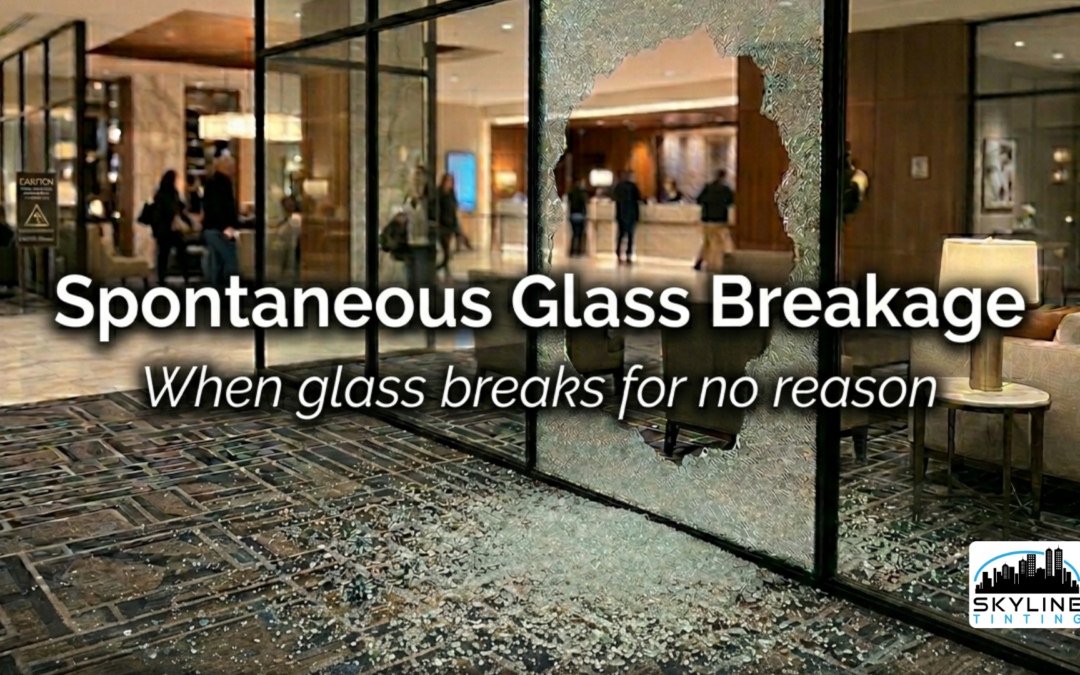
You walk into your office on a Monday morning and find a pile of small glass cubes scattered across the lobby floor. The storefront window — the one no one touched, the one that had no visible cracks — has shattered completely. No impact. No storm. No explanation.
If this sounds familiar, or if it sounds like something you’d rather never experience, keep reading. Spontaneous glass breakage is a real and well-documented phenomenon in commercial buildings, and it’s more common than most property owners realize. Here’s what’s causing it, why tempered glass is uniquely vulnerable, and what you can do right now to protect your people and your property.
“Despite the industry’s recognition of this problem since the early 1960s and manufacturers’ efforts to limit it, spontaneous fracture of fully tempered glass continues to be an issue in architectural glazing to this day.”
What Is Spontaneous Glass Breakage?
Spontaneous glass breakage is exactly what it sounds like — tempered glass that shatters without any visible external cause. No rock. No impact. No dramatic temperature swing. The glass simply lets go, often with a loud bang, and disintegrates into hundreds of small cubes.
According to a detailed analysis published in Construction Specifier magazine, spontaneous breakage in commercial buildings can be traced to three main culprits: nickel-sulfide inclusions, thermal stress, and frame-related stress. Understanding all three matters if you own or manage a commercial building in the Hampton Roads area.
Industry Research & Field Documentation
The Three Causes of Spontaneous Breakage in Commercial Glass
Sources: Construction Specifier | Vitro Architectural Glass
The Three Causes of Spontaneous Breakage in Commercial Glass
1. Nickel-Sulfide (NiS) Inclusions — The Hidden Ticking Clock
This is the cause most people in the industry talk about, and for good reason. Vitro Architectural Glass (formerly PPG Glass), one of North America’s leading glass manufacturers, has published technical documentation specifically addressing this issue. Their research explains that tiny nickel-sulfide particles can form randomly during the float glass manufacturing process. The problem isn’t the particles themselves — it’s what happens to them during tempering.
When glass is tempered, it’s heated above 600°C and then rapidly cooled. This rapid quenching “freezes” any nickel-sulfide particles in a high-temperature crystalline state. Over months or years after installation, those particles slowly try to revert to their natural low-temperature form — and in doing so, they expand in volume by 2 to 4%. That expansion generates localized internal stress that can reach as high as 125,000 psi at the particle’s surface.
When the inclusion sits in the core tension zone of the glass pane, it’s only a matter of time. The microcracks spread until the entire pane gives way — suddenly, without warning, often producing a distinctive “butterfly” fracture pattern radiating from a central point.
Giroux Glass, a nationally recognized commercial glazing contractor, has documented this firsthand. After investigating a spontaneous breakage, their field team identified the cause by locating the butterfly pattern at the break’s epicenter — the telltale signature of a nickel-sulfide failure.
NiS Inclusion: What the Industry Data Shows
Sources: Vitro Architectural Glass | Giroux Glass | Construction Specifier
What makes this especially frustrating is that there is no practical way to detect these inclusions through visual inspection. Vitro Architectural Glass is explicit in their technical documentation: no technology currently exists to completely eliminate nickel-sulfide stone formation in float glass production. Every tempered pane carries some statistical risk — it’s built into the manufacturing process itself.
2. Thermal Stress — When the Sun Works Against You
Construction Specifier magazine highlights thermal stress as another common and often underappreciated cause of spontaneous breakage. This one is particularly relevant to commercial buildings in coastal Virginia, where sun exposure is intense and seasonal temperature swings are significant.
A thermal stress break occurs when the center of a glass pane heats up significantly faster than the edges, which are shielded inside the frame. The center expands while the edges remain cooler and more rigid. The resulting tension can exceed the glass’s tolerance, causing it to crack or shatter.
The Hampton Roads Factor
GlassOnWeb, an industry trade publication, notes that thermal stress risk is especially pronounced in modern commercial buildings with large glass panels and high-performance solar control coatings. That’s exactly the type of glazing common in today’s office parks, retail centers, and mixed-use developments along the Hampton Roads corridor — from Chesapeake to Virginia Beach to Newport News.
3. Frame-Related Stress — An Installation Problem That Shows Up Years Later
The third cause is more straightforward but no less damaging. Construction Specifier explains that when gaskets, setting blocks, or edge blocks in a metal window or curtain wall frame are missing, worn, or improperly installed, the glass loses its cushion against the metal frame. Seasonal expansion and contraction then drive the frame into direct contact with the glass edges — gradually chipping, nicking, and stressing the glass until it eventually fails.
This type of failure is particularly insidious because the root cause — a missing gasket or a bad original installation — may have occurred years before the glass breaks. There’s nothing in the visible condition of the glass to warn you.
Why Tempered Glass Is Specifically Vulnerable
You might be wondering: isn’t tempered glass supposed to be the safe option? It is — in a lot of ways. Tempered glass is approximately four to five times stronger than standard annealed glass, and when it does break, it shatters into small, relatively blunt cubes rather than large jagged shards. That’s why building codes require it for storefronts, entry doors, sidelights, and other high-traffic commercial locations.
But tempering is also precisely what makes spontaneous breakage possible. The rapid cooling process that creates tempered glass’s strength is the same process that traps nickel-sulfide inclusions in their unstable crystalline state. As Construction Specifier notes, nickel-sulfide inclusions only cause spontaneous breakage in tempered glass — not in annealed or heat-strengthened glass — because of this characteristic of the tempering process.
The industry trade publication GlassOnWeb put it plainly: spontaneous breakage is a known, ongoing issue in architectural glazing that has persisted despite decades of manufacturer awareness and quality control improvements.
The Real Risk: Flying Glass in a Commercial Setting
Here’s the concern that matters most for business owners and property managers. When a tempered glass storefront, partition, or window fails spontaneously, the breakage isn’t always gentle. Depending on how the pane is installed and how much energy is stored in the glass at the moment of failure, cube-shaped fragments can scatter across a wide area. In high-traffic commercial environments — lobbies, retail floors, restaurant dining rooms — that means employees and customers can be directly in the path of flying glass.
Why Commercial Buildings Face Elevated Risk
The glass doesn’t have to be sharp to cause harm. Flying at speed, even blunt cube-shaped fragments present a real injury hazard. And for managers of multi-story commercial buildings, the concern extends beyond the floor — glass falling from elevated heights to the ground below is a serious liability exposure.
What 3M Safety Window Film Does About It
This is where 3M Safety and Security Window Film changes the equation. While it can’t prevent tempered glass from breaking — no film can — it can fundamentally change what happens when it does.
3M’s Safety and Security Window Films are designed to hold broken glass together after a failure event. When applied to the interior surface of a tempered glass pane and combined with 3M’s Impact Protection Attachment (IPA) Sealant along the frame perimeter, the film bonds to the glass fragments and keeps them in place — in the frame — rather than allowing them to scatter across the floor or fall from elevation.
3M specifically lists spontaneous glass breakage as one of the primary applications for their safety film products, alongside windstorms, seismic events, blast mitigation, and forced entry. Their Scotchshield Ultra Series and Safety Series films are optically clear, meaning the appearance of your windows remains unchanged. The protection is invisible until it’s needed.
3M Safety Window Film + IPA Sealant System
With Film vs. Without Film When Glass Fails
- Fragments scatter across wide area at high speed
- Broken pane can fall out of frame entirely
- Immediate injury risk to anyone in path
- Elevated glass can fall to grade level below
- Facility closure, liability exposure, emergency cleanup
- Film bonds fragments together — glass stays in one piece
- IPA Sealant anchors broken pane to the frame
- No scatter, no flying debris, no injury exposure
- Elevated glass remains retained at height
- Controlled, non-emergency replacement on your timeline
The IPA Sealant component is a critical part of the system for spontaneous breakage applications on single-pane tempered glass. Without it, the film alone may hold the fragments together but the broken pane could still fall out of the frame. The sealant bonds the film edge to the frame, anchoring the entire broken pane in place. For commercial buildings along Hampton Roads — whether you’re managing a multi-tenant office, a retail strip, a restaurant, or a medical facility — this is a practical and cost-effective layer of protection that most property owners haven’t considered.
“Tempered glass is stronger than standard annealed glass, but factors such as imprecise installation or impurities in the tempered glass can result in spontaneous glass breakage. 3M™ Safety & Security Window Film combined with 3M™ Impact Protection Attachment (IPA) Sealant can help.”
What You Can Do Today
There’s no way to look at a piece of tempered glass and know whether it has a nickel-sulfide inclusion working against it. That’s the uncomfortable reality the industry acknowledges. What you can control is what happens if and when a pane fails.
3M Safety and Security Window Film, professionally installed by a certified dealer, gives your tempered glass a containment system it doesn’t currently have. Your storefront glass, conference room partitions, lobby windows, and elevated curtain wall panels can all be addressed — quickly, cleanly, and without disrupting your business operations.
Protect Your Commercial Property
Ready to Add a Layer of Protection to Your Tempered Glass?
At Skyline Tinting, we’re a 3M Authorized Window Film Dealer serving commercial properties throughout Chesapeake, Virginia Beach, Norfolk, and the surrounding Hampton Roads area. We’ll walk your property, assess your glazing, and put together a recommendation that fits your facility and budget.
Give the specialists at Skyline Tinting LLC a call at
757-695-8444
or
message us today
.
Because the best time to address spontaneous glass breakage is before it happens.
Sources:
Vitro Architectural Glass — Nickel Sulfide and Spontaneous Breakage
Construction Specifier — Spontaneous Glass Breakage: Why It Happens and What to Do About It
Construction Specifier — Fully Tempered Glass and Spontaneous Fracture
GlassOnWeb — Spontaneous Breakage
GlassOnWeb — Preventing Thermal Stress Breakage
Giroux Glass — How Nickel Sulfide Inclusion Causes Spontaneous Glass Breakage
3M — Safety & Security Window Film Solutions
3M Scotchshield Ultra Series Window Film
3M Safety Series Window Film