How Specialized Window Film Is Putting an End to Deadly Bird Strikes
Every year, hundreds of millions of birds across North America die from collisions with glass — a largely preventable problem that has quietly become one of the most significant human-caused threats to bird populations on the continent. But a landmark installation at one of Chicago’s most recognizable buildings has demonstrated that a straightforward, cost-effective solution already exists — and the results are hard to ignore.
Source: WTTW News | American Bird Conservancy
The Bird Strike Problem — By the Numbers
A Single Night That Changed Everything
Chicago’s McCormick Place Lakeside Center is an architectural landmark — and, until recently, a serious hazard for migratory birds. With roughly 120,000 square feet of reflective glass facing Lake Michigan, the building sits directly along the Mississippi Flyway, one of the most heavily traveled migration corridors in North America.
During a single night of fall migration in October 2023, nearly 1,000 birds lost their lives after colliding with the building’s glass facade. The event made national headlines and prompted immediate action from conservationists, scientists, and city officials alike.
The Science Behind the Story
For years prior to the 2023 incident, biologists from the Field Museum of Natural History had been quietly documenting bird fatalities at McCormick Place and other high-risk sites across Chicago. That long-term data collection — led by retired bird collections manager Dave Willard — proved invaluable. It established the scope of the problem and provided the scientific baseline needed to measure the impact of any intervention. Their decades of meticulous monitoring made the before-and-after comparison possible.
“McCormick Place Lakeside Center deserves hearty appreciation and recognition for the steps they have taken to drastically reduce bird collisions at their facility. Their efforts will encourage others across the nation to take steps to make glass and lighting safer for migratory birds.”
— Martha Williams, Director, U.S. Fish & Wildlife Service
The Solution: Bird Strike Reducing Window Film
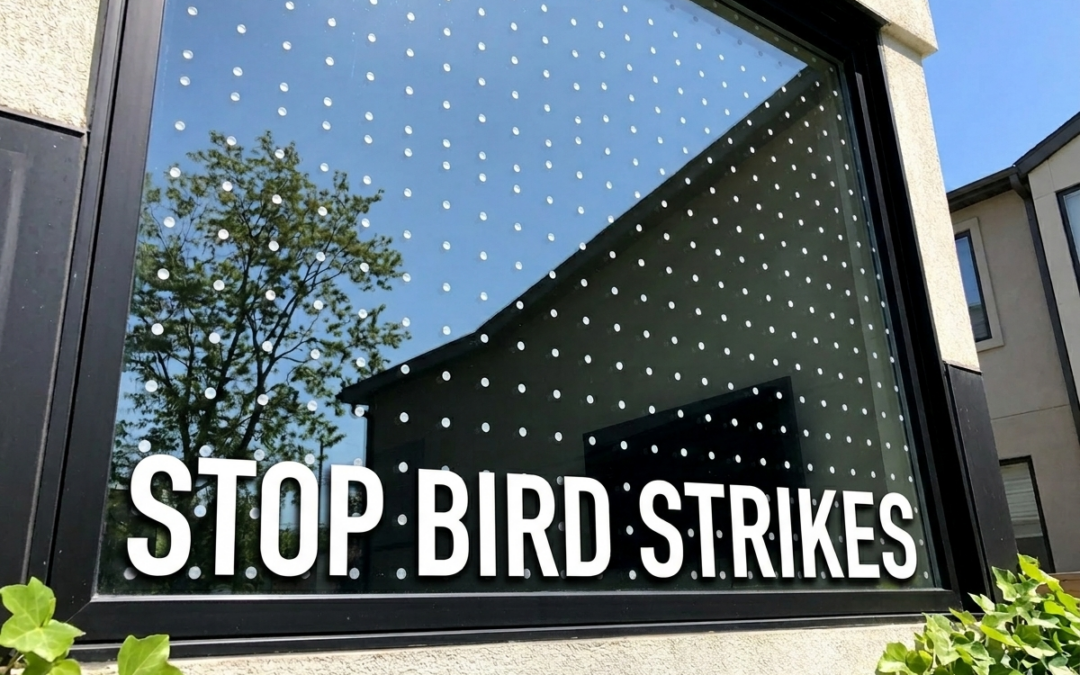
In the summer of 2024, McCormick Place undertook a $1.2 million pilot installation of specialized bird collision reduction window film. The chosen film — Feather Friendly® — featured a pattern of small white dots arranged on a two-inch grid across the building’s exterior glass, a design grounded in decades of ornithological research.
McCormick Place Installation — Key Details
Source: WTTW News — McCormick Place Window Facelift | Chicago Sun-Times
The Results: A 95% Reduction in Bird Deaths
The outcome following the first post-installation migration season was remarkable. Reported bird fatalities at McCormick Place dropped to fewer than twenty — a 95% reduction compared to prior seasons. Species that had previously fallen victim to the building’s reflective surfaces were now navigating safely past it.
McCormick Place Lakeside Center — Fall Migration
Before the Film vs. After the Film
during October 2023 migration
on the Mississippi Flyway
the entire first post-installation migration season
Field Museum of Natural History researchers
Source: WTTW News, January 9, 2025 — Patty Wetli | American Bird Conservancy
“The only way you’ll eliminate strikes entirely is if you remove all the glass in this building. But to reduce it by 95% is pretty dramatic. And when you start extrapolating that over all the years and extrapolate it over all the buildings in Chicago if they were also treated, those are massive numbers.”
— Matthew Groleau, Feather Friendly®, via Chicago Sun-Times
The Science Behind It
Birds collide with glass because of a fundamental visual deception. Reflective surfaces mirror sky and surrounding vegetation, while transparent glass appears to offer a clear flight path. To a bird in flight — especially at night during migration — neither presents an obvious barrier.
Effective prevention requires breaking that illusion. Exterior-applied films, ceramic frit patterns, and UV-reflective markers all work by creating visible obstacles that signal the presence of a solid surface. The polka-dot film at McCormick Place is a direct application of this principle — simple in concept, and now proven effective at scale.
The Ornithological Standard for Effective Bird Film
Studies consistently show that visual markers must be spaced no more than 2 inches apart horizontally and 4 inches vertically for birds to perceive glass as a solid surface rather than an open flight path. The exterior application is a critical distinction — interior films offer little to no protection because approaching birds cannot see them.
Small, fast-moving species such as warblers, thrushes, sparrows, and hummingbirds are among the most frequently affected. Given that an estimated 365 million to one billion birds die annually from building collisions across North America, the urgency of scalable solutions cannot be overstated.
A Blueprint for Buildings Nationwide
What makes the McCormick Place project particularly significant is its potential as a replicable model. The $1.2 million investment — substantial, but modest compared to full glass replacement or large-scale facade redesigns — delivered measurable conservation results after a single migration season.
The U.S. Fish & Wildlife Service is now actively working to promote bird-friendly building practices through federal property guidelines and voluntary adoption programs. Partnerships with the National Park Service, healthcare institutions, universities, and other major building owners are expanding the reach of these initiatives beyond major urban centers.
Bird-Friendly Building Policy — Where It Stands
Source: WTTW News — Bird-Friendly Ordinance | U.S. Fish & Wildlife Service
What This Means for Your Building
Bird-friendly window film is not exclusively a solution for landmark buildings or major municipalities. The same principles apply to office complexes, retail centers, schools, healthcare facilities, and residential properties — any structure where glass surfaces create a collision risk. Here in Hampton Roads, where migratory flyways pass directly through the region along the Atlantic coast, the issue is closer to home than many building owners realize.
Key Advantages
Why Bird Strike Reducing Window Film Makes Sense
Source: Chicago Sun-Times | Feather Friendly®
A Proven Model — Ready to Scale
McCormick Place’s transformation from a major bird collision hotspot to a national model for wildlife-conscious design is a compelling demonstration of what targeted, science-backed intervention can achieve. A 95% reduction in bird deaths — accomplished with film rather than reconstruction — makes a clear case that protecting migratory birds and maintaining modern architecture are not competing goals.
The film doesn’t obstruct light or the view from inside. It requires no ongoing maintenance. And as the data from Chicago’s Field Museum confirms, it works from the very first migration season after installation.
Serving Hampton Roads — Virginia Beach, Norfolk, Chesapeake & Beyond
Has Your Building Experienced Bird Strikes?
The specialists at Skyline Tinting LLC can help identify the right bird-friendly film solution for your home or commercial property. Contact us today for a free, no-obligation quote.
Sources:
WTTW News — Bird-Friendly Glass at McCormick Place Is Working, January 9, 2025 (Patty Wetli)
WTTW News — McCormick Place Window Facelift Underway, July 12, 2024 (Patty Wetli)
WTTW News — Bird-Friendly Building Ordinance Back on the Table, July 23, 2025
Chicago Sun-Times — Thousands of Bird Deaths Averted at McCormick Place, January 8, 2025
American Bird Conservancy — Efforts at McCormick Place to Prevent Bird Window Strikes
Window Film Pros — Bird Strike Reducing Window Film
Feather Friendly® — Bird Collision Deterrent Film
Skyline Tinting LLC — Bird Safety Window Tinting Services